Feed library

The reading room

Ars Technica

20 articles/Updated Visit source
Atom feed Refresh

This preview uses the same feed and article caches as your subscriptions.

01"At Home in Space" opens, caps Air and Space Museum renovation - Ars Technica
Read on arstechnica.com

news-103026a-lg-1152x648.jpg


After seven years of work and nearly $1 billion, the Smithsonian has completed the renovation of the National Air and Space Museum’s flagship building in Washington, DC.

On October 30, the museum debuted its last-to-open spaceflight exhibition, returning “home” with a gallery devoted to establishing a spacefaring civilization.

“Welcome to ‘At Home in Space’!” said curator Jennifer Levasseur, who guided us through a virtual tour of the gallery. “This is the story of long-duration spaceflight in the last few decades. We generally call it ‘reaching orbit.’”

“It’s the prep story, the space shuttle story. It’s what allows us to end up at a place where we have 25-plus years of long-duration spaceflight experience, the capacity for humans to be living in space on the International Space Station (ISS), and then it carries that story forward. So the middle of our story then becomes the ISS, and the end of the story are the next steps,” said Levasseur.

Entering “At Home”

Over the past several years, the National Air and Space Museum has introduced new galleries showcasing how US astronauts first entered space and landed on the Moon (“Destination Moon”); how robotic probes have explored every planet in our solar system (“Kenneth C. Griffin Exploring the Planets”); how technologies and infrastructure impact our daily lives (“RTX Living in the Space Age Hall”) and what approaches spaceflight will take in the years to come (“Futures in Space”).

“At Home in Space,” which follows the similarly themed “Moving Beyond Earth,” immerses guests in the equipment, spacecraft, and orbital platforms that have enabled humanity from simply visiting space to living there, setting up the near future for bases on the Moon and Mars.

“We have a great way to attract people into the gallery, which is this overhead mock-up of an astronaut on the end of the robotic arm, and then the backdrop to that is this photo mural—a full-size photo print—of the ISS,” said Levasseur. “Our astronaut up here is intended to be [an actual] person, but I’m not going to share who that is. They are wearing an Expedition 60 patch, so that’ll give you a little clue.”

Outer space outfits

Some of the gallery’s artifacts include a space shuttle main engine, Robonaut 1A (a prototype humanoid robot), and an extravehicular mobility unit (EMU) spacesuit.

“It’s pretty damn special,” said Levasseur of the EMU. “This, as far as I know, is the first and potentially only public display of a fully flown set of EMU equipment in the world. I know NASA has one in its EVA office, but it is not on public display.”

Unlike Apollo-era spacesuits sized to each astronaut, the EMU was designed to be reused, so its components can be swapped out to fit astronauts of different sizes. Introduced during the early years of the space shuttle program, the same EMU suits are still used on the International Space Station for US spacewalks.

The museum’s example is only missing a functioning portable life support system (PLSS), as all the backpacks are still needed for use. So the suit on display only has a PLSS shell for now, according to Levasseur.

The gallery also features Guy Bluford’s and Sally Ride’s in-flight suits, the “shirt-sleeve” outfits the first African American and first US woman wore on the space shuttle (on separate missions).

“Sally is notably missing her jacket, which was a late change to our plan. We were given a drawing of this, a 3D mockup of its display case, and our designers then put it in this way without the jacket on. And we thought, ‘Hey, that’s actually kind of a nice contrast. Let’s keep the jacket out,’” Levasseur told collectSPACE.

The gallery also includes recovered components from the Challenger and Columbia tragedies. It is only the second public display of fallen orbiter debris after a Kennedy Space Center Visitor Complex exhibit that opened in Florida in 2015.

“We wanted to honor the individuals who were lost during the shuttle program,” said Levasseur. “So we have an elevon hinge from Challenger that washed up on the beach a few years ago and a little wiring panel fragment from inside the payload bay. And then from Columbia we thought it was appropriate to help tell that story with a piece of RCC [reinforced carbon-carbon]. This is a T-panel from the starboard wing. We also have a CD [compact disc] on a long-term loan from David Brown’s family.”

Inside ISS

Visitors can also walk through a full-size mock-up of the space station’s Destiny module, the US national laboratory on the station, and view its equipment on both sides, as well as above and below.

“Originally, the detailing on the floor was going to be a mosaic of real images, but we found that for accessibility reasons people might come in and see the cables and worry that they were real, creating a tripping hazard,” said Levasseur. “On the flip side, and I had to fight to get these, we had to have labels to indicate activity happens on the floor and happens on the overhead. People need to see this is a literally three-dimensional space.”

The module has interactive elements on one side and showcases some of the crew equipment-related artifacts, including coffee cups engineered for use in microgravity.

“This is probably the best section in my mind because it has fun stuff,” said Levasseur, pointing out the flown miniPCR biotech toolkit and MinION portable device used to sequence DNA in space for the first time.

“My absolute favorite thing to work on in this gallery answers the questions: What does space smell like, and what does the ISS smell like? We have little scent oils inside each of these that allow people to smell them,” she said.

Nearby, the  first 3D printer used in space is also on display. In 2014, Made In Space (now part of Redwire) and NASA flew the printer, which produced hundreds of objects, from astronaut tools to space station repair parts.

Awaiting Artemis

The gallery concludes with a space reserved to exhibit the Artemis I capsule, the spacecraft that flew without astronauts to the Moon in 2022. A Lockheed Martin scale model of Orion holds the place until NASA delivers the real spacecraft to the Smithsonian, which is expected later this year.

“This is the piece of Wright Flyer fabric that went to the moon with Artemis II, so that’s on display here, too,” Levasseur said, concluding the tour.

The renovation of the National Air and Space Museum also included refacing the exterior cladding, replacing mechanical systems, and other improvements. The first half of the museum reopened in 2022 with eight new or reimagined galleries, the Northrop Grumman Planetarium, museum store, and the Mars Café. The second phase opened in 2025 with five new galleries, and five additional galleries opened July 1.

Following “At Home in Space,” “Modern Military Aviation” will open on November 11.

“We are thrilled to complete the most extensive project the museum has ever undergone,” Chris Browne, John and Adrienne Mars Director of the museum, said in a statement. “With the opening of these last two galleries, the public will once again be able to visit the entirety of the museum and learn from and engage with the nation’s world-class aerospace collection.”

Admission to all of the National Air and Space Museum galleries remains free, but timed-entry passes for the building are required to visit.

02Why large dogs age faster than small ones, and other October research highlights - Ars Technica
Read on arstechnica.com

doggos-1152x648-1793464886.jpg


It’s a regrettable reality that there is never enough time to cover all the interesting scientific stories we come across. So every month, we highlight a handful of the best stories that nearly slipped through the cracks. October’s list includes an epigenetic mechanism for why large dogs age faster than smaller ones; physicists who trapped a single particle of antimatter for months; and invisible tattoo inks that only show up under UV light.

Why large dogs age faster

In many mammalian species, larger creatures tend to have longer lifespans. Mice, for instance, live an average of just two years, while some whales can last for as long as 200 years. Dogs, however, buck this pattern; larger dogs tend to age faster and die younger than smaller ones, which makes canines an ideal model for biologists to study to learn more about aging in general. Arizona State University scientists report that these lifespan differences seem to be due to so-called “jumping genes,” according to a paper published in the journal Science.

The authors used data from 864 dogs collected in the Dog Aging Project to map patterns of DNA methylation (which influences how much certain genes are turned on or off)  across the entire genome. It’s part of the epigenome, whose markers can change over time in response to stress and other environmental factors. Genetic sequences, by contrast, are largely fixed. So DNA methylation is a good chemical indicator of aging and DNA regulation.

Their analysis showed that aging in dogs is linked to the decrease in the regulation provided by DNA methylation, particularly in regions where there are “jumping genes” that can move from chromosome to chromosome. These jumps can damage DNA, causing cancer and other age-related diseases, and their activity increases with the loss of regulatory markers. The authors identified a specific class of jumping genes called LINE1s that were responsible for the different rates of aging in dogs. Giant dog breeds lost roughly 35 percent more LINE1 methylation each year compared to small breeds.

“This is one of the clearest molecular signatures we’ve seen that aligns with the well-known size-lifespan trade-off in dogs,” said co-author Blaise Mariner. “It suggests that faster aging in larger dogs may be driven, at least in part, by reduced control over these jumping genes.”

Science, 2026. DOI: 10.1126/science.aeb2986 (About DOIs).

Trapping an antimatter particle for months

Gerald Gabrielse/Northwestern University

One of the biggest unanswered questions in cosmology is why the early universe had a fundamental asymmetry between matter and antimatter. When matter and antimatter particles collide, they annihilate into energy, so that asymmetry resulted in matter dominating our universe, which contains much more matter than antimatter. It’s extremely difficult to create and isolate antimatter, requiring special traps. Physicists at Northwestern University have succeeded in trapping a single positron (antimatter particle) for months on end, according to a paper published in Physical Review Letters.

Co-author Gerald Gabrielse and his team built on earlier work, in which they trapped a single electron to create a one-electron quantum cyclotron. They then used the setup to make one of the most precise measurements of its magnetic moment yet. Trapping a positron was a bit trickier. They harvested the positron from sodium-22 nuclei, slowing it down enough to guide it into a near-perfect vacuum trap of electric and magnetic fields. Once inside, they chilled the positron to just 300 millikelvins (0.3° above absolute zero), thereby keeping the positron in its quantum ground state. They found they could maintain that state for months at a time.

That enabled Gabrielse et al. to manipulate and detect the particle’s individual quantum energy state using tuned microwaves—the first critical step in being able to measure the positron’s magnetic properties, hopefully with the same precision they achieved in their earlier experiments with a single electron. The Standard Model of particle physics predicts that there should be no difference between the two particle measurements. If they are not equal, “that would be the biggest discovery in physics in the last century,” said Gabrielse.

Physical Review Letters, 2026. DOI: 10.1103/gbkc-6nlj.

Invisible tattoos that show up under light

Many people sport tattoos, but there are situations where hiding them is desirable. A new line of multicolored tattoo inks could one day make that dilemma moot; they are invisible to the human eye unless one illuminates them with UV light, according to a paper published in the journal Matter & Light. “There’s a stigma, in science and in many cultures, around body art,” said co-author Carson Bruns of the University of Colorado, Boulder, who sports a green lion tattoo on one arm, among others. “I’m proud to be pushing against that.”

As previously reported, epidermal electronics attached to the skin via temporary tattoos (e-tattoos) have been around for more than a decade. So-called e-tattoos connect to skin without adhesives, are practically unnoticeable, and are typically attached via temporary tattoo, allowing electrical measurements (and other measurements, such as temperature and strain) using ultra-thin polymers with embedded circuit elements. In 2024, researchers developed special polymer-based conductive inks that can be printed onto a person’s scalp to measure brain waves, even if they have hair. This could one day enable mobile EEG monitoring outside a clinical setting, among other potential applications. And earlier this year, scientists at Pennsylvania State University developed a novel conductive ink that can be painted directly onto the skin in colorful custom designs, turning into a functional electrode for biomonitoring after drying.

Bruns et al. created their inks, known as PhotoTat, from color-changing dyes injected into tiny spheres of polymethyl methacrylate (PMMA), a material used in dermal fillers among other medical applications. Mixing the primary-colored dyes can create full-color images. The tattoos are invisible until exposed to UV light, when they turn blue, magenta, or yellow. They fade after a few hours, faster if exposed to bright LED light. It’s still a proof of concept, but Bruns did test the dyes on himself, inking a black outline of fish scales that turn red, orange, or blue, like mermaid scales, under UV light. The dyes could also help cancer patients undergoing radiation therapy, who need small tattoos so doctors can guide the beams. PhotoTat would make such tattoos invisible except when the treatment is being administered.

Matter & Light, 2026. 10.1016/j.matlit.2026.100119.

Westminster skeleton likely a monk

Over 150 years ago, archaeologists discovered a skeleton buried in a Roman sarcophagus on the grounds of Westminster Abbey, bearing an inscription to a wealthy Briton from between 300 to 400 CE named Valerius Amandinus. But there was also a Latin cross sculpted into the lid that dated to the 10th or 11th century, i.e., the late Saxon period. Were the remains actually those of someone who lived and died centuries after Valerius? According to a paper published in the Journal of the British Archaeological Association they are—specifically, these are the bones of a high-ranking medieval monk.

The authors reasoned that this was an abbot’s skeleton because it was buried within a sarcophagus, while skeletal clues suggested it was a man between 35 and 49, standing about 5 feet, 9 inches tall. The most likely conclusion is that the bones belong to a Benedictine monk named Aelfwig, who died around 1020 and was buried at Westminster Abbey, where he had served as abbot. However, the bones may also be those of Aelfwig’s successor, Wulboth, who died in 1049 and was likely buried on the grounds as well. There is also evidence that the body was originally housed in a timber coffin that decayed over the ensuing seven centuries.

Journal of the British Archaeological Association, 2026. DOI: 10.1080/00681288.2026.2675788.

More on how Botticelli’s favorite model died

In June, we reported on the research of Paolo Pozzilli of Queen Mary University of London and several co-authors into the cause of death of one of Sandro Botticelli’s models. Among his best-known works is the Birth of Venus, depicting the naked goddess, newly birthed, standing in a giant scallop shell. The model for the painting (disputed by some historians) was allegedly Simonetta Vespucci (née Cattaneo), a renowned beauty in Florentine high society whom Botticelli greatly admired. He painted her five times before her untimely death in her early 20s.

It was long believed that Simonetta had succumbed to tuberculosis, but it was argued that she may have suffered from a pituitary tumor (adenoma) that gradually increased in size due to prolactin and growth hormone secretions, citing her appearance in several portraits as evidence. This could have caused a sudden tumor-related fatal apoplexy. They examined letters between Simonetta’s father-in-law, Piero Vespucci, and Lorenzo de Medici, which described how Simonetta had collapsed during a ball a few days before her death. Her symptoms included headache, hallucinations, vomiting, and a high fever, all symptoms of a rapidly expanding pituitary tumor, per the authors.

Pozzilli et al. are back again with a paper published in the journal Medical Humanities providing further evidence for their hypothesis about Vespucci’s cause of death. They argued that the tumor could also explain the irregular eye positioning in the Birth of Venus, suggesting the model had a squint or eye misalignment. After more closely studying how Botticelli depicted the model’s eyes in Birth of Venus and several other portraits, the authors noted pronounced swelling around the left eye, likely due to fluid buildup, while some of the tissue covering the white part of the eye is loose. This and the telltale squint support the theory that Simonetta had a tumor in her pituitary gland.

Medical Humanities, 2026. DOI: 10.1136/medhum-2026-014199.

Dating van Gogh’s Starry Night

Vincent van Gogh’s masterpiece, The Starry Night (1889), has long fascinated art lovers and scientists like. Some physicists have even suggested that the painting is a masterful depiction of atmospheric turbulence, and a 2024 paper found that the illusion of movement in the blue sky is also due to the scale of the paint strokes—a second kind of “hidden turbulence” at the microscale that diffuses throughout the entire canvas, although others have objected to that conclusion. Now a team of South Korean astronomers has used “forensic astronomy” to pinpoint the precise month in which van Gogh painted his masterpiece, according to a paper published in the journal Scientific Reports.

Other astronomers have previously suggested that The Starry Night is not just a symbolic representation, but shows the actual night sky at the time it was created, specifically in June 1889. This new analysis—which takes into account simulations, historical weather patterns, star positions, and van Gogh’s letters from that year—shifts that date to just before dawn on July 22, 1889. Co-author Elijah Jeong-hyun Kim told Gizmodo that his interest was piqued when he came across previous research identifying the constellation Aries. Kim thought the lights in the painting more closely resembled the Hyades star cluster in the constellation Taurus, suggesting the July date. While van Gogh said that his work exaggerated the point of view he painted, the authors note that such exaggeration “presupposes a real object to amplify.”

Kim et al. are in good company in forensic astronomy. As we reported in 2020, the so-called “celestial sleuth,” Donald Olson, applied similar tools to determine that Vermeer’s View of Delft most likely shows the city on September 3 or 4, 1659 (or earlier), at 8 am. Over the years, Olson has found evidence that the blood-red sunset that inspired Edvard Munch’s The Scream was likely an aftereffect of the 1883 eruption of Mount Krakatoa in Indonesia; that the Moon may have contributed to the sinking of the Titanic; helped identify the precise location of Julius Caesar’s landing site in Britain in 55 BC; and showed that Mary Shelley was probably telling the truth about a moonlit “waking dream” that inspired Frankenstein. And in 2015, Olson determined the precise time of day that Life magazine photographer Alfred Eisenstaedt took his most famous photograph (V-J- Day in Times Square)  on August 14, 1945.

Scientific Reports, 2026. DOI: 10.1038/s41598-026-73025-5.

03Third person dies of bird flu since virus started jumping to livestock - Ars Technica
Read on arstechnica.com

GettyImages-2190742287-1152x648.jpg


A person in Washington state has died from bird flu after exposure at an infected dairy farm, state health officials reported Sunday. It marks the third human bird flu death in the US since a strain of highly pathogenic (H5) avian influenza (HPAI) made the unprecedented jump from wild, migratory birds to dairy cows, which was first reported in the US in March 2024.

The person who died was a Yakima County resident and was said to have had underlying health conditions, which could have made the person more vulnerable to the infection. On Friday, county officials reported that the person was severely ill and hospitalized. In the subsequent announcement of the person’s death, officials said they would not be releasing further information about the person, including their name, gender, or age, out of respect for the family’s privacy.

“Our hearts go out to the individual’s family and loved ones during this difficult time,” Dave Atteberry, health officer for the Yakima Health District, said in a statement. “Avian influenza can cause severe illness, particularly among people who have underlying health conditions. While this is a serious and heartbreaking outcome, the risk to the general public remains low.”

Continued threat

In all, three people have tested positive for bird flu in Washington since the virus was reported in dairy cattle in the state on October 8. All three have been in Yakima County. While announcing the death on Sunday, officials also reported the third case. That case, like the first case, was in a person who had exposure to an infected dairy herd in the county. Both people have reportedly not experienced severe illness nor been hospitalized.

Since the October 8 report of infected herds, Washington state has had 40 detections of bird flu in dairy cows, according to the US Department of Agriculture. Most of those have been in Yakima County, which has reported detections in 33 herds.

This year, the USDA has reported 134 cases of bird flu in cattle, including cases in Texas, Washington, Idaho, Utah, and Kansas. The USDA lists no other reports of cases in other domestic livestock, including swine. But the virus has continued to spread in other wild and captive mammals. A report last month from ProPublica revealed that the virus is raging on a mink farm in Utah. The report raised alarm because mink is a species that could give the virus opportunities to mutate to better spread among humans.

To date, no human-to-human transmission of HPAI has been reported from the over 70 human cases detected since 2024. Of the cases, only three have resulted in death. The first death was in a 65-year-old Louisiana resident with underlying health conditions, who became critically ill in January 2025 after exposure to infected wild and backyard birds. The second death, in November 2025, was reported by Washington state officials as an older adult with underlying health conditions who also had exposure to infected backyard birds.

04Googling "Zelda" today offers a glimpse of how search worked in 1998 - Ars Technica
Read on arstechnica.com

zelda-google-1152x648.jpg


The year was 1998. Britney Spears topped the charts, Bill Clinton was impeached, and a couple of little websites called Google and Ars Technica came online. It was also the year Nintendo released The Legend of Zelda: Ocarina of Time on the Nintendo 64. Google, which has come to dominate the Internet (Ars is still working on that), is celebrating the imminent release of the Ocarina of Time remaster by temporarily transporting us back to that storied year with a search Easter egg.

To access the Google time machine, you just have to search for either “Zelda” or “Ocarina of Time.” Google will load the standard 2026 results page, but you’ll see an animated Master Sword in the lower right corner. It appears on both mobile and desktop—just click the sword and enjoy the show.

After a little time-skipping animation and a Link shout (you know the one), you’ll swear it’s 1998 again. The search page is transformed into a simple list of blue links with retro Google branding. This is particularly apt given the time-shifting mechanics in Ocarina of Time.

Classic Google used to provide a list of 10 links on each page, but there are only seven included in the Easter egg. This is a curated list of links rather than a real search. You get the official Nintendo Zelda page, Zelda on Wikipedia, Zelda games on Amazon, and a couple more.

You can go back to the modern version of Google’s search results at any time by clicking the sword again. Oh, you don’t want to do that? Sadly, this is a very limited experience. The Google of today is much different, and if you try to search for anything from the retro interface, you are immediately booted back to 2026 with all the AI, sponsored content, suggested searches, and social media links.

The Ocarina of Time left its mark on a generation of gamers, and clearly, some of them went on to work at Google. The company’s intention is probably to leverage nostalgia to build hype for Nintendo’s big launch, but there’s also something a little sad about this. Google’s push into generative AI is transforming search in a way that many people don’t like. Seeing the simple, minimalist roots of Google search on display drives home how much the company’s core product has changed.

The Ocarina of Time has changed a lot, too. The remastered game has been completely re-created, with slick Switch 2 graphics, modern controls for movement and camera, numerous quality-of-life improvements, and more. The game is available for preorder now at $60 for digital and $70 for physical. It launches on November 5 for Nintendo Switch 2.

05Most of our measures of a key cognitive process don't agree - Ars Technica
Read on arstechnica.com

GettyImages-2182089944-1152x648.jpg


It’s widely acknowledged that it’s nearly impossible to publish negative results in scientific journals. “We didn’t see anything” is a much harder sell than finding that a hypothesis is clearly right. Findings of no effect tend to either be shuffled off to low-profile journals or left behind as unpublished lab lore.

The high-profile journal Nature, however, made a notable exception this week, publishing a study that tells us that a bunch of methods we have been using to try to measure a key emotional ability don’t seem to be measuring the same thing. The results mean that we don’t have a good way to measure the impact of a concept that is the basis of a key method in therapy.

Inconsistencies

One of the most successful forms of therapy is cognitive behavioral therapy, or CBT. In part, CBT is based on getting people to step back and engage in “cognitive reappraisal.” This requires people to think over a situation that has caused a negative emotional response and find ways to reinterpret it so that it has less impact on them. The ability to engage in this process has been linked to emotional resilience.

Given its importance, a lot of studies have looked at what’s going on in the brain when people engage in cognitive reappraisal. There are also a number of questionnaires that are thought to measure a person’s capacity to engage in the process. So, a large international collaboration of researchers decided to look at these more carefully. “We focused on three widely used indices that are often assumed to reflect related facets of reappraisal capacity: trait questionnaires, task-based affective ratings following reappraisal, and amygdala down-regulation during reappraisal,” they wrote.

The amygdala is a structure deep in the brain that tends to be active when people have emotional responses to events (as well as in a wide variety of additional circumstances). So, it makes sense to expect that it would be less active if people were trying to tone down their emotions. But to find out whether that’s actually correct, you need to look at brain activity. Here, the team relied on 40 functional MRI data sets, providing a large enough data set to tease out even relatively small effects.

Which is a good thing, because the effects really were hard to detect. “The effect size was comparatively small: To detect this effect size with a statistical power of 80 percent, a single study would need to test 1,105 participants,” the researchers note, going on to say that very few fMRI studies have access to anywhere near that many subjects.

But there were even bigger problems when the differences among individuals in the MRI data were compared to their differences in the questionnaires or task-based ratings. Almost none of the variance in the different measures correlated with each other. We could go through the numbers, but a figure from the paper makes the issue quite clear.

An issue of timing?

Further issues became apparent when the researchers started looking at activity in the areas of the brain that are responsible for high-level decision-making. If people were really engaging their ability to re-evaluate emotional triggers, presumably these areas should be active, as they are needed to power the re-evaluation process.

But that wasn’t what the fMRI data showed. Instead, there was a correlation between the response of the amygdala and the response elsewhere in the brain. In other words, if the amygdala was very active, implying a stronger emotional response, then activity in the decision-making areas of the brain was also higher. If the emotional response seemed tamped down, then activity in the reasoning centers was lower as well.

In a bit of an understatement, the researchers declared, “These findings call for a fundamental reassessment of how reappraisal capacity is measured and interpreted across behavioural and neural levels of analysis.”

The primary issue is that these three ways of looking at emotional regulation were thought to be exploring the same thing, but it’s clear that they’re not. As the researchers point out, this probably shouldn’t be viewed as a surprise. The questionnaires typically ask about overall personality tendencies, and so cover a very long time period. The answers are also likely to implicate a variety of traits beyond simple emotional control.

Both the task-based ratings and fMRI work, by contrast, capture in-the-moment responses. But they do so under very, very different experimental circumstances—namely, one of them involves being stuffed in an MRI tube. Beyond that, many of the fMRI experiments involve simplifying the process of emotional regulation in order to get consistent data. It’s entirely possible that these differences also influence brain activity in a variety of ways.

So, the take-home appears to be that re-evaluation of emotional responses may be a real phenomenon, but we don’t currently have tools that can clearly capture the process effectively. Gaining that ability may require developing new methods, and thinking more clearly about what different stages of the re-evaluation process require. In the meantime, the people behind this work caution that “strong claims about a person’s emotion regulation capacity based on any specific brain region should be made with considerable caution.”

Nature, 2025. DOI: 10.1038/s41586-026-11203-1  (About DOIs).

06Coming in 2027: Apple’s $1,000 home robot for FaceTime and switching on lights - Ars Technica
Read on arstechnica.com

Apple-CEO-John-Ternus-1152x648.jpg


Apple’s new CEO, John Ternus, is apparently pushing the tech company’s development of household robots—and the first to debut may be a home robot designed to autonomously roam around while supporting FaceTime calls and switching lights on whenever a person enters the room.

People who worked on Apple’s robotic projects told The Information that the AI-driven home robot, code-named J595, could be named HomeView Ultra in line with Apple’s new HomeView stationary smart display. The company is reportedly aiming to launch the robotic product with a possible price tag of $1,000 or more by 2027, although development delays may push that back to 2028.

The earliest prototypes of the home robot first came out in 2018 and received approval from former Apple CEO Tim Cook to continue the project. The Information describes Apple’s engineers as trying to give the robot more capabilities beyond being a “fancy way to make FaceTime calls” in order to justify a high price tag, even as the team has spent years refining the software and incorporating more AI technologies.

However, the robot’s few reported features seem underwhelming so far when compared with existing smart home devices and systems, or even a run-of-the-mill robot vacuum with a clearer use case for households. Is there a market for a smart home device costing more than $1,000 that moves around while hosting FaceTime calls, automatically handling room lights, and occasionally ordering the family cat to get off the dining table?

One of the Information’s sources also described Apple as having a very small team of about 10 “true roboticists,” with many members of the initial engineering team having departed over the years. The software side boasts a significantly larger team of approximately 300 people.

Still, Ternus has been backing this home robot as well as a separate Apple project focused on developing robots for household tasks like folding clothes, according to The Information. The latter would presumably require robotic arms and manipulators, though it’s unclear if that means Apple has ambitions to develop a general-purpose humanoid robot for household use like robotics startups 1X and Figure AI.

From a technical and safety standpoint, Apple’s initial focus on a limited-purpose home robot still makes much more sense right now than any attempt to develop a general-purpose autonomous robot that could pose greater risks when operating near humans. The question is whether Apple can find enough customers willing to pay whatever it charges for a limited-purpose home robot.

07Claude’s new rules against game cloning won’t stop the AI copying boom - Ars Technica
Read on arstechnica.com

GettyImages-1180626096-1152x648.jpg


Last week, Anthropic introduced a new system prompt designed to stop its Claude models from re-creating specific, existing video games. While that move could help shield Anthropic from some liability, it’s unlikely to slow much of the massive wave of AI-assisted game porting and copying that has emerged in recent months.

A social media user and AI decompilation enthusiast going by the name “chasm” was among the first to note the prompt change late last week, saying a new rule seemed to be added to the Claude Code prompt on or around October 27. That rule—included in a json file under the name “tengu_heron_brook”—reads as follows:

Do build original games, games in a genre, and games from the user’s own designs and assets. Don’t build a recreation of a specific existing game, even if it is renamed or called original.

XDA later independently verified that the new rule appears in version 2.1.314 of the Claude Code binary, which was released on October 30. XDA also reported that the “tengu_heron_brook” rule had been used for other purposes in earlier versions and that the Claude Opus 5.5 model specifically seemed to have its own distinct and independent instructions restricting game recreations as part of its system prompt bundle.

Following chasm’s initial report, Anthropic software engineer Addy Osmani confirmed on social media that the company had “added two sentences to Claude Code’s prompt on Opus 5.5 to steer it away from recreating someone else’s specific game because using Claude to infringe IP is against our usage policy.”

He added that the new prompt was designed to still allow “original games, genre games, and games built from your own designs and assets,” even as a handful of issue reports on Anthropic’s GitHub suggest the new prompt is getting in the way of some game development use cases.

We added two sentences to Claude Code’s prompt on Opus 5.5 to steer it away from recreating someone else’s specific game because using Claude to infringe IP is against our usage policy.

Original games, genre games, and games built from your own designs and assets are meant to keep working.

We’ll continue to iterate to ensure we’re striking the right balance. In the meantime, if Claude turns down something that’s yours, send it my way.

— Addy Osmani (@addyosmani) October 30, 2026

A massive wave

Anthropic’s new prompt comes as AI coding tools are powering a deluge of game projects based on existing work in one way or another. That includes thrown-together copies of game demos that are making some developers afraid to show their early work publicly, as well as thousands of AI-powered decompilation and porting projects for retro games. Thanks to AI tools, what used to be a time-consuming process requiring painstaking human effort is now orders of magnitude more efficient (though some veteran coders complain that these vibe-coded ports and decomp projects fail to clear the same quality bar as human-centered efforts).

The trend has gotten so bad that decomp.dev—a years-old community devoted to the “brutally difficult, time-consuming task” of game decompilation—announced it was shutting down last month. Community maintainer Luke Street wrote that quickly improving AI tools had made it clear that “community aspect of decompilation has been broken” as newcomers “rac[e] to port games, especially utilizing decompilations that they did not contribute to.”

“Decomp.dev was originally designed to gamify decompilation: watching the progress go up was a fun way to stay motivated when every fraction of a percent took real human effort,” Street wrote. “Today, that same idea has warped decompilation into a hollow numbers game, exacerbated by folks who just want to burn tokens to make number go up or ‘port game to PC,’ all else be damned.

Like trying to stop the tides

While Anthropic’s new prompt can be seen as a noble effort to push back against the flood of AI-powered, vibe-coded copying, it seems unlikely to have much impact overall. That’s primarily because eager game copiers can simply shift to any of the other frontier models that haven’t introduced such restrictions. And even if the AI industry as a whole began to bar this kind of use case, coders could switch to cheaper open-weight models that aren’t subject to these kinds of restrictions and are not all that far behind in capabilities.

The prompt may have a more immediate benefit for Anthropic, helping protect the company from potential liability for copyright infringement in these projects. We’ve seen how AI companies face legal headaches if their models generate images based on copyrighted works, for instance. As Osmani noted in confirming the new anti-game copying prompt, “Using Claude to infringe IP is against our usage policy”—a policy that’s surely in place to protect the company legally.

Decompilation efforts based on reverse engineering code generally pass legal muster as long as “expressive elements” like art and sound assets are not included in the project. But there’s no guarantee that individual vibe-coders using Claude would be so careful with their efforts, even with Anthropic guardrails against IP theft in place.

On the other hand, there’s a risk that Anthropic’s efforts could prove too restrictive, limiting transformative game projects that build off existing work. Take, for instance, the increasingly popular trend of using AI to merge two different game concepts into one, adding Mario to Elden Ring or Spider-Man to Batman: Arkham Knight, for instance. Are these the kinds of “recreations of a specific existing game” that Claude’s new prompt should block? Or are they transformative works that are legally and creatively distinct from what inspired them? And how does the use of copyright-protected characters and images factor in?

Beyond mashups, how should a model like Claude ensure there’s a difference between a direct re-creation of Tetris (ostensibly disallowed by the new prompt) and a mere game in the Tetris genre (ostensibly allowed by the prompt)?

These are issues that even courts can have trouble adjudicating in the best circumstances. Asking an AI model to reliably draw the line between acceptable and unacceptable game clones is a tall order, even with a new two-sentence prompt in place.

08China publicly discloses plan for a lunar landing within three years - Ars Technica
Read on arstechnica.com

china-1-1152x648.jpg


Chinese space officials confirmed this weekend that the Asian nation plans to land its astronauts on the Moon within three years.

At the Seventh Manned Spaceflight Conference in Beijing, officials, including Wang Xiang, chief designer for the lunar exploration program, laid out the country’s most publicly detailed plans yet for a series of missions leading up to a crewed lunar landing “before 2030.”

China’s lunar landings will involve a lunar-orbit rendezvous similar to what NASA did in the 1960s and early 1970s with the Apollo program. However, lacking a rocket as powerful as the Saturn V vehicle, the crew and lunar lander will launch separately to the Moon.

According to slides shared on social media, the current plan involves:

  • An uncrewed test of the Long March 10A rocket (a single-stick variant, with no boosters) and the Mengzhou spacecraft to low-Earth orbit. Target: early 2027
  • An uncrewed test of the larger Long March 10 rocket (a core stage with two boosters) and the Lanyue lunar lander, including descent/ascent from Moon’s surface. Target: 2028
  • A concurrent launch of two Long March 10 rockets, one carrying uncrewed Mengzhou and the other the Lanyue vehicle; they will dock in lunar orbit. Target: 2029
  • Dual launch of Long March 10 rockets, this time with crew on the Mengzhou spacecraft, leading to crewed landing mission. Target: “Before 2030”

The public release of this new information provides a timeline for gauging China’s technical progress in its efforts to land humans on the Moon before 2030 and beat NASA and the United States back to the lunar surface.

Notably, the plan (for now, at least) omits a mission similar to Apollo 8 or Artemis II, which involved a crew flying out to the Moon and either entering orbit or passing close by before returning to Earth. The Mengzhou vehicle should still get a workout closer to Earth with humans on board as part of missions carrying astronauts to Tiangong, China’s space station in low-Earth orbit.

China’s program has been largely opaque

NASA has set a target of landing humans on the Moon by 2028, a year or so ahead of China. The United States, which has been working on the Space Launch System rocket for 15 years and the Orion spacecraft even longer, has a more established rocket and crew vehicle.

But there are major questions surrounding the development of a lunar lander, for which both SpaceX and Blue Origin have multibillion-dollar development contracts. Depending on how these projects go, a US lunar landing could be delayed to 2030 or even later.

Although it is virtually impossible for outsiders to glean information about technical milestones achieved inside China’s space program, the country is clearly making credible progress toward reaching the Moon. For example, in August 2025, the China Manned Space Agency successfully tested a high-fidelity mock-up of its 26-ton Lanyue lunar lander. The test used giant tethers to simulate lunar gravity as the vehicle fired its main engines and fine-control thrusters to land on a cratered surface and take off from a location near Beijing.

Recently, the Mengzhou spacecraft for the 2027 test atop a Long March 10A rocket arrived at the Wenchang Space Launch Site in Hainan, China, where the mission will launch.

US government assessments of the Chinese space program are restricted, but lawmakers are clearly taking the threat seriously. In the last 12 months, the US Congress and White House have given broad latitude to NASA Administrator Jared Isaacman to streamline the Artemis Program to land humans on the Moon. He has moved swiftly to cancel the Lunar Gateway space station and planned upgrades to the Space Launch System rocket. And just last week, Isaacman announced plans to help Blue Origin develop a lunar lander by finding a way to boost the Orion spacecraft into low-lunar orbit.

“We have the mandate, we have the resources, and the support from our stakeholders to be able to execute, and that’s what we intend to do,” he said at the time.

For a couple of years, it has been clear that China has made a major commitment to landing astronauts on the Moon, preferably before the United States returns to the lunar surface, to score a major geopolitical win. Beyond this near-term competition, both NASA and China’s space program are building capabilities to establish a long-term presence at the Moon’s South Pole. As part of this second phase of the contest, Isaacman committed NASA to the development of a base on the surface of the Moon over the next decade.

09F1 in Mexico City: Yet another Ferrari fiasco, but that’s not all - Ars Technica
Read on arstechnica.com

GettyImages-2302218135-1152x648.jpg


Formula 1 has a new World Drivers’ Champion. Just a few months after turning 20, Kimi Antonelli sealed his first title this weekend at Mexico City, becoming the sport’s youngest-ever champion. Elsewhere, there was drama aplenty, perhaps a consequence of the thin air affecting decision-making in some cases. The race was Ferrari’s to win, but yet again, the team handed victory to a rival this season, in this case Red Bull. Further down the grid, we saw a last-minute driver change in the Haas team, synchronized retirements from both Aston Martins, and the wheels literally coming off Cadillac Racing. And there was I, expecting a dull weekend.

It might not be as high as Pikes Peak, but at an elevation of 7,350 feet (2,240 m) above sea level, the Autódromo Hermanos Rodríguez provides a unique challenge on the F1 calendar. Wings that would create huge amounts of downforce at circuits like Monaco just generate Monza-like levels in Mexico, and there’s little slipstream effect when following another car.

Cooling tends to be a problem, too, with insufficient airflow across radiators, and obviously engine power is reduced with less oxygen to burn. The track is very flat, with a rather low-grip surface and mostly medium- and slow-speed corners, including a processional route through a stadium that was built in the 1990s, plus a very long run from the start into turn 1.

Friday’s first practice saw 10 rookie drivers substitute in for series regulars—each team must run a young or test driver in each of their two cars at least twice in a season. Make that six times in the case of Cadillac?

1+30+7+4=40?

The American startup team wants IndyCar star Colton Herta to race in F1, but Herta needs a total of 40 points over three years to get the requisite F1 super license. Sadly, his IndyCar record was too inconsistent—10th place in 2023, 2nd in 2024, but then 7th again in 2025—so he entered F2 this year, both to learn the circuits and to finish well enough in that championship to earn the remaining points.

That hasn’t happened, but you also earn a point for completing 100 km in an FP1 session, and Herta stepped into the Cadillac in Barcelona, Italy, Hungary, and in Texas. His run in Italy was cut short by unreliability, so Cadillac put him in the car again this weekend, hoping it would be the final run.

But it turns out they hadn’t added the numbers properly. Rather than pulling Herta’s IndyCar results from the official scoring, the team apparently relied on IndyCar’s erroneous website. Instead of starting the year with 36 super license points, Herta only had 35, and with four successful FP1 runs under his belt, he still needs one more point if the team wants to replace an underperforming Valteri Bottas next year, something that should happen with another run next time out in Brazil.

It’s not the first time that paperwork has proved to be a problem for the American team, which almost lost a chance to enter the sport after FIA emails went to its spam folder in 2024.

Friday’s second practice session also had more action than normal. Max Verstappen and Liam Lawson both sat out FP1 so rookies could drive their cars, which may have contributed to both being too eager to set a fast time in FP2. As Lawson’s Racing Bull got held up by Carlos Sainz’ slow Williams in front, Verstappen wanted past in the Red Bull, but both drivers were intransigent, and neither was prepared to yield. Paint was traded and cars were damaged, and both drivers were handed a one-place grid penalty for failing to behave themselves.

FP2 also probably marked the end of Esteban Ocon’s F1 career, at least for now. The French driver was upset with his team about their choice of tires for his long run, which evidently escalated once he was out of the car. On Saturday, Ocon had been benched and replaced with Ryo Hirakawa, Haas’ reserve driver and two-time World Endurance Champion with Toyota. Haas had already announced that Ocon was not rejoining the team in 2027, opting instead for F1 driver Rafael Camara, who will probably race for the team in Brazil, as Hirakawa will be racing his Toyota that weekend.

At 32, Ryo Hirakawa is quite old to be making his F1 debut.
Rudy Carezzevoli/Getty Images)
At 32, Ryo Hirakawa is quite old to be making his F1 debut. Rudy Carezzevoli/Getty Images)
Max Verstappen (L) and Liam Lawson (R) getting a bit too robust during Friday practice.
Bradley Collyer/PA Images via Getty Images
Max Verstappen (L) and Liam Lawson (R) getting a bit too robust during Friday practice. Bradley Collyer/PA Images via Getty Images
At 32, Ryo Hirakawa is quite old to be making his F1 debut. Rudy Carezzevoli/Getty Images)
Max Verstappen (L) and Liam Lawson (R) getting a bit too robust during Friday practice. Bradley Collyer/PA Images via Getty Images

Ferrari screwup

For most of this year, Ferrari has had a particular form. The team often tops the practice times on Friday but then fails to follow up on Saturday, often in the final qualifying session. That didn’t happen in Mexico, and Lewis Hamilton was able to claim his first pole position for Ferrari and his 105th in the sport. George Russell’s Mercedes qualified second, followed by Charles Leclerc’s Ferrari. Verstappen should have been fourth, but that Friday clash saw Antonelli moved into that spot. As it happens, the grid demotion put Verstappen on the clean side of the track, which he used to his advantage.

Both Ferraris got off the line well, as did Verstappen and Antonelli. Russell’s hybrid system derated halfway down the straight, ruining his race well before the first corner. With Hamilton in the lead and Leclerc in second place, the plan should have been obvious: settle into a 1-2 and win the race. Unfortunately, the idea of supporting his teammate is utterly alien to Leclerc, who showed us why he has 27 pole positions but only nine wins in eight years. Once more this year, the Ferraris raced each other as if a championship were at stake, and once more they snatched defeat from the jaws of victory.

Going into turn 4, both drivers went off track and rejoined. The race stewards had been extremely clear that leaving the track and gaining a permanent advantage at turns 1 or 4 on the first lap would result in a penalty unless the driver gave the place back. Hamilton did not gain a lasting advantage, but Leclerc did, staying in clean air up front and building enough of a lead that the paltry five-second penalty that was eventually handed down kept him ahead of Hamilton after their stops.

But it didn’t keep him ahead of Verstappen, who stopped at the same time as Leclerc but emerged in the lead, a lead he would keep until the end.

These cars sure break down a lot

It wasn’t an easy drive to the checkered flag, however. We’re accustomed to Lance Stroll’s Aston Martin breaking down on track and triggering a safety car or a virtual safety car, and this race was no exception. It happened early, on lap 7, while the other Aston Martin, driven by Fernando Alonso, retired to its garage.

Cadillac has also had plenty of reliability problems this year, usually with its front brakes overheating. It was even more serious in Mexico: On lap 44, Bottas’ front left suspension failed as he approached turn 1. The heavy crash forced a red flag to repair the barrier, bringing the race to a halt and necessitating a second standing start.

Verstappen kept the lead, demonstrating the superior power output of the Red Bull power unit, even at altitude, over Ferrari’s. A furious Hamilton passed Leclerc, who compounded his original error by badly locking his front tires, wearing a flat spot down to the cord. The safety car came out again on lap 59, when Arvid Lindblad’s Racing Bull was taken out by McLaren’s Oscar Piastri.

Up front, Hamilton followed Verstappen by a few tenths of a second but without ever having the speed to try an overtake. The Ferrari might not have had the legs to get past the Red Bull, but its tolerance for riding the curbs, plus the small turbo’s punch out of low-speed corners, was sufficient to give it the edge over 2025 champion Lando Norris’ McLaren, which finished in fifth behind Leclerc.

After the race, Ferrari team principal Fred Vasseur said, “I always expect everyone to show respect for the brand, the team, our partners and, above all, the 2,000 people working for us back home. They put an incredible amount of effort into what we do, working day and night at the factory to improve the car and bring upgrades to the track. That’s why missing out on a win in this way is difficult to accept.”

“The core thing to remember, which maybe comes with age, is that every decision you make in the car impacts all the people that work in the background for the whole team,” said a frustrated Hamilton after the race. “A part of our contract is we have to work as a team, which we could have easily done today. So it’s a shame to see us lose as we did. And that will continue unless action is taken, and a real deep, serious conversation is had, so it shouldn’t happen moving forward.”

Hamilton pointed to Leclerc’s “do-or-die, either I win or none of us do” attitude as a problem, ruing the loss of what could have been the team’s best result all year. “It was just unnecessary,” he said. “I think we could have easily had that 1-2, which would have been huge for the team and for everyone back at the factory who’s worked so hard to bring us these upgrades.”

Other teams have laid down clear rules to determine the way teammates race each other—at Mercedes, Toto Wolff began making Hamilton and Nico Rosberg pay for any damage they caused to the cars if they came together on track, and McLaren had its famous Papaya rules. At Ferrari, both drivers are free to race each other, and both are jockeying to be seen as team leader for next year. Now Vasseur has to try to get both Hamilton and Leclerc under control, because if Ferrari keeps giving away race wins like this, his position has to be increasingly untenable.

10The world has a new plan to save nature, but it still needs the money - Ars Technica
Read on arstechnica.com

1620px-Jabiru_-_Garzon_Soldado_Jabiru_mycteria_8576613973-1152x648.jpg


The world is set to miss its 2030 conservation goals as finance and action have fallen short, leaders recognized at a UN biodiversity summit in Armenia’s capital, where they agreed to step up efforts after a final overnight session.

Representatives from almost 200 countries gathered in Yerevan over the past two weeks to review progress on a landmark agreement set four years ago to protect about a third of the world’s land and seas by 2030.

The COP17 talks on biodiversity concluded on Saturday with a recognition that conservation efforts were so far too slow to realistically achieve the goals of the 2022 Kunming-Montreal Global Biodiversity Framework.

A plan was agreed to accelerate progress ahead of the next summit in Ecuador in two years, dubbed the Yerevan Pathway. It would mean redoubling efforts to tackle subsidies and incentives that are harmful to nature, increasing financial, scientific, and technical support for developing countries, and strengthening monitoring and reporting mechanisms.

Steven Guilbeault, former Canadian minister of environment and climate change, said that finance remained one of the biggest obstacles to achieving global biodiversity goals.

The fact that a fund agreed at the last meeting—for companies profiting from genetic materials to voluntarily contribute to—stood largely empty was “especially disappointing.”

“We need to mobilize substantially more public and private finance, reform subsidies that harm nature, and ensure that funding reaches the countries and communities on the front lines of the nature crisis,” he said.

Catherine Weller, global policy director at the campaign group Fauna & Flora, said the Yerevan agreement was welcome but also noted that funding fell far short of a pledge that had been a key part of the 2022 deal. “In a world of trillionaires, we can certainly afford to spend $200 billion a year on protecting and restoring the very thing keeping us all alive: nature,” she said.

Conference organizers said governments, philanthropists, and businesses had announced close to $2 billion in new financial commitments to coincide with the Armenian gathering.

This included a commitment by the Netherlands to contribute $500 million to the Tropical Forest Forever Facility, a Brazilian initiative to pay countries to keep their forests standing. The pledge was announced in the Dutch parliament the day after Brazilian leader Luiz Inácio Lula da Silva was re-elected as president, to the relief of many attending the biodiversity summit.

After the close of the conference, Carina Pimenta, Brazil’s national secretary for bioeconomy, highlighted Lula’s record of protecting the Amazon rainforest and spoke of hope. “At a time of growing global uncertainty, the Yerevan Declaration sends a powerful message: world leaders recognize that protecting biodiversity is essential to food security, livelihoods, and economic resilience,” she said.

A growing number of countries to have drawn up national diversity plans, and the new pledge to the Brazilian fund, were “reasons for cautious optimism,” said Brian O’Donnell, director at Campaign for Nature.

But international funding for protected and conserved areas has fallen in a number of countries over years of disruption from war and high energy prices, with a 27 percent decline in environmental funding for the 2026-30 period.

© 2026 The Financial Times Ltd. All rights reserved. Not to be redistributed, copied, or modified in any way.

11This $48 e-paper display can be whatever you want it to be - Ars Technica
Read on arstechnica.com

TRMNL_Seeed_Kit_Ferengi_Rules-1152x648.jpg


One of the most useful gadgets in my kitchen is now a screen that never asks me for anything.

I recently bought a $48 DIY display kit from Seeed Studio (yes, that’s three E’s), developed in collaboration with TRMNL, that lets me display whatever I want, using whichever software ecosystem I prefer.

I previously built something similar by modding a Lenovo ThinkSmart View, which was selling for around $30 on eBay during a liquidation. The Lenovo device was only ever intended for business-to-business video, but it does a decent job of running a fork of LineageOS. Unfortunately, its limited RAM makes it sluggish. So when I came across the TRMNL kit and its e-paper display, I was sold.

I’d have an always-on display that shows me the information I want, with no subscription required. And since the screen populates automatically, I would never have to wrestle with a slow interface.

The Seeed Studio kit and TRMNL ecosystem aren’t trying to compete with products like the recently announced Apple HomeView, a $299 home hub designed to get the whole family interacting with it. If anything, the TRMNL kit is the HomeView’s antithesis. It’s designed to be entirely passive: The e-paper display stays on, cycling through potentially useful information on your desk or in your kitchen, from calendars and weather to news and all sorts of ideas thought up by its community members.

Here’s how it works.

Choosing a path

TRMNL, the platform company, was founded by indie hardware enthusiast Ryan Kulp in 2023. Its first e-paper device launched via crowdfunding in 2024.

Seeed Studio provides the hardware. The established Shenzhen open hardware company is best known for its XIAO microcontroller boards.

In March 2025, Seeed teased an XIAO e-paper panel on social media, prompting a community member to ask whether it could run TRMNL firmware. The question brought the two teams together, and in July 2025, they announced an official partnership to develop a DIY e-paper kit combining Seeed’s hardware designs with TRMNL’s firmware packages.

Seeed designs and manufactures the hardware, while TRMNL maintains the firmware, plugins, and hosted service. But you’ll still need to make some decisions about how to set up the kit. There are three ways to get it running, depending on your budget and how comfortable you are with managing software yourself.

The stock TRMNL setup connects you with the company’s “BYOD ecosystem” (bring your own device), letting you use trmnl.com as your information server with a 14-day free trial. After that, you’ll need to pay a one-time $50 license fee to keep your device connected to TRMNL servers.

If you’d rather go your own way, Seeed offers software options, including Home Assistant compatibility, that don’t require a TRMNL connection or license. You can also access the SenseCraft Seeedash platform, which includes a plugin repository and design workspace. It’s worth checking out the options before committing to a $50 TRMNL license. The browser-based platform also includes a firmware-flashing tool Seeed describes as simple enough for anyone to use.

If you already have a server up and running, you can point the device right at it. Terminus is TRMNL’s open source container for this setup. The Terminus GitHub page describes the BYOS as providing “privacy first functionality by empowering you to run your own private server, network, and devices. You own the stack and the data.”

The e-paper display and control board simply ping an API to retrieve the information to display. You can even write plugins in HTML, which the screen renders as a bitmap. The trade-off is that your server needs to stay online, and maintaining it may bring some system-admin headaches some users may want to avoid. But hey, that’s why there are options.

An example of a weather app on the Seeed firmware.
The display refreshing feeds while loading.
You can edit the list from your phone.
The display refreshing feeds while loading.
You can edit the list from your phone.

What’s in the box?

  • XIAO ePaper Display Dev Board with XIAO ESP32-S3 Plus onboard
  • 7.5-inch monochrome ePaper display (800 × 480 pixels)
  • FPC extension cable (10 cm)
  • FPC connector
  • 2,000 mAh rechargeable Li-ion battery
  • Wi-Fi antenna

Two official case designs are available for 3D printing: a triangular prism and an L-shaped case. I went for the latter, and although I’d hoped assembly would be as simple as plugging everything in and slotting the pieces into place, it proved to be a bit more involved.

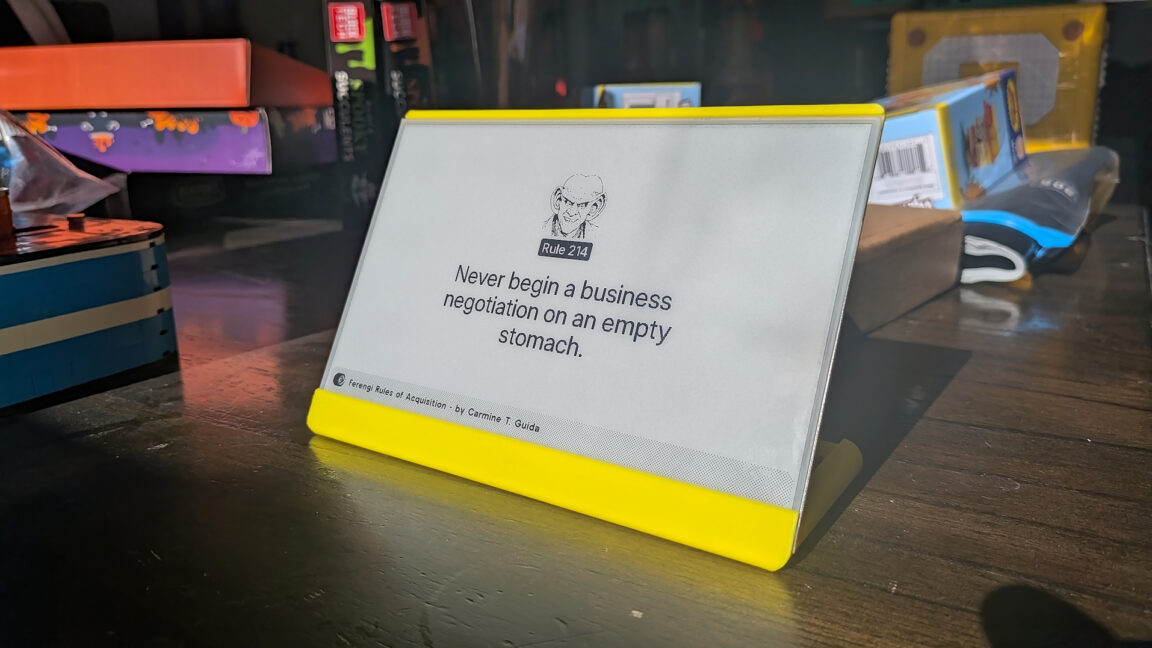
The kit came with all the hardware I needed, with one slight hiccup: I’d forgotten to order a case or display stand. Fortunately, TRMNL is a proper DIY project, and there are print files available for recommended stand setups. A quick print at my local library’s Bambu printer and $8 solved the problem. I probably should have chosen something other than “dealer’s choice” for the PLA color, as I ended up with a bright canary yellow device case. At least it stands out on my kitchen countertop.

I’d recommend trying the prism shell design over the L-style case I chose because the latter required me to cut a channel for the ribbon cable extension. It wasn’t a huge deal for a project like this, but you may need to do some extra work and fiddle with the fit. You’ll also need needle-nose pliers to remove the print’s support trees from the narrow space.

Assembly

Before trying to fit everything into the printed case, I wanted to make sure the hardware worked, so I connected the parts on my workbench. The case-less assembly couldn’t be simpler: Connect the battery or a USB-C power source, plug the display directly into the board, and you’re good to go. From there, connect your phone or tablet to the device’s Wi-Fi and enter your local Wi-Fi credentials.

If you attempt this build, be aware that it involves some delicate parts. The FPC is extremely fragile and can break if you force it to bend in a direction it doesn’t want to go (say, around the sharp angle of an L-shaped case). Getting the cable to conform to the design was challenging; I tried using tweezers to coax the cable around the bend but got nowhere fast.

Connecting and routing the ribbon cable extension was the most stressful part of the assembly. The case design just doesn’t accommodate the path the ribbon cable naturally wants to take. Following a helpful tip from a commenter on MakerWorld, I managed to snake the cable through the narrow passage by attaching a bit of paper tape to the end of the ribbon connector.

After powering on the kit for the first time, you’ll see the TRMNL logo and a QR code on the e-paper display. Scanning the code redirects you to a “How to set up a new device” guide written by Kulp, the TRMNL creator. The guide had been updated just 15 minutes before I clicked the link—a promising sign of a living document that is constantly evolving.

TRMNL.com

I wasn’t planning to use the trmnl.com service, but I wanted to get a sense of what it offered for its $50 access fee. The 14-day “free” trial is a misnomer, though. Before you can register your device, you’ll need to enter your credit card information and pay $1 for access. After plopping down a buck, the next screen welcomed me to my trial.

After registering your kit’s MAC address with trmnl.com, you’ll receive what the service calls a “friendly code,” a much shorter identifier that’s easier to remember than an entire MAC address. From there, you can install plugins to display content on a schedule throughout the day.

The options are vast. The marketplace contains standard fare like Google Calendar, weather, and stock quotes, alongside more niche offerings like rotating factoids about the Ferengi Rules of Acquisition in Star Trek.

If you’re looking for a hassle-free solution that “just works,” it’s hard to fault the package trmnl.com has put together. I’m a fan of any service that offers a one-time license fee over yet another forever subscription, and I think $50 is a fair price for the people behind the platform to be compensated for their work. After all, it handles all the rendering; the device simply displays information pulled from the APIs.

SenseCraft

On the Seeed side, there’s SenseCraft, a similar marketplace to trmnl.com’s but without the license fee. The website offers a browser-based flashing tool that promises to “flash official firmware from the browser. No coding. No terminal. Just clicks.”

The process was as simple as promised—once I figured out that I needed a USB-C to USB-C cable. I connected the board to my PC via the onboard USB-C port, opened the website in a Chromium-based browser (sorry, Firefox), selected my device from a drop-down menu, and clicked “Flash.” Once the device rebooted, setup followed essentially the same process as it did with TRMNL, minus the credit card. The tradeoff for free access is that Seeed is based in China and operates under its own privacy policy. Your call, but it’s certainly nice to have options.

After registering a Seeed account, I entered a code displayed on the device, just as I had with TRMNL. SenseCraft’s marketplace is similarly packed with community contributions, but I had trouble determining which plugins were intended for my device and which might not be compatible. I tried publishing several different feeds to the display, but I couldn’t get them to render.

SenseCraft leans heavily into AI-powered custom designs. While the platform offers a bit of everything, much of its content is geared toward the Chinese market, with English-language apps sprinkled throughout. I can see why US users reached out to ask about TRMNL compatibility.

Bring your own server

As TRMNL puts it, “the goal isn’t for BYOS to match parity with our hosted solution but to provide enough of a pleasant solution for your own customized experience.” Even a modest homelab server should have no trouble running the Terminus package, which acts as an API point that takes in information, renders the designs, and sends them to your e-paper display. The process shouldn’t put meaningful strain on most systems.

It’s great that there’s an “easy” version for a fee, but homelabbing is one of my favorite hobbies, and I love self-hosting projects wherever possible. When I first saw the DIY TRMNL/Seeed package, I was hoping I’d be able to control the feed myself.

For now, getting Terminus running on your server isn’t as simple as heading to your OS’s Docker app store and downloading a host service. TRMNL has a great guide to walk you through the setup, but if you’re not comfortable working with docker compose files, you may want to pay the one-time license fee and leave the hosting to TRMNL.

I won’t lie: I spent some late nights banging my head against the desk trying to get everything running. I’d initially tried hosting it on my main Unraid machine, but I kept running into bridge networking issues. The Terminus package is a multi-container compose stack with pieces like Sidekiq worker, Postgres, Valkey, and a certificate initializer. If those containers can’t communicate with each other, nothing works.

Thankfully, I’m a weird nerd who also runs a CasaOS deployment on another machine. After I executed the bin/setup script there, everything worked as it should. The next issue was flashing back to the latest TRMNL firmware package. My unit arrived with FW 1.5.12, well behind the current 1.8.18 release.

Flashing proved to be an annoyance again because I struggled to keep the unit in flashing mode and get the web flasher to communicate with the serial port on my Fedora PC. After about 30 minutes of troubleshooting without making progress, I switched to my MacBook Pro, where the process worked on the first try. Go figure.

Once you’ve updated the display to the proper firmware and pointed its connections at your server, you can write and design your own display templates. If starting from scratch isn’t your thing, TRMNL’s own plugins repo and a community-maintained catalog are available. A new Extensions Gallery in the Terminus web UI lets you import certain plugins for local hosting.

The options are almost overwhelming, and I imagine it will take some time to get everything dialed in exactly as I want it. I still plan to stick with the BYOS route, but the process isn’t as straightforward as I had hoped. For example, the setting for pointing the display at your local server is hidden under the “advanced” settings page during the web portal login.

Real-world impressions

Once I deployed the display in my kitchen, I could get a better sense of how it would fit into my day-to-day life. The 7.5-inch e-paper display is large enough to read from across the room, and all the plugins I had running looked crisp and legible. My son was enamored with the lunar cycles display and commented that “now I’ll always know what moon we have.”

That’s where the kit shines: showing little rotating bursts of useful information that you might never have thought to look up before.

Seeed Studio says the display can run for three months on battery power. I haven’t had the device long enough to verify that claim, but I’m not sure I need the battery for much more than backup. The device powers via USB just fine, so I’ll probably leave it connected to a nearby hub on the counter. The three-month estimate assumes that the display will update once every six hours. I prefer refreshes closer to once an hour, which would cut battery life significantly. Either way, the battery becomes largely irrelevant if you use a USB power source.

Final thoughts

The official TRMNL route is starting to look mighty tempting if it means getting the type of headache-free, set-it-and-forget-it Ron Popeil experience I was expecting from this setup. I’ll keep tinkering with the BYOS solutions, but since those still run on the official TRMNL firmware, I may switch back and use the rest of my 14-day trial to see what best suits my needs. The $50 license fee would push my total project cost over $100. That’s not a huge deal, but it’s double what I was expecting.

The TRMNL/Seeed Studio collaboration has produced a true DIY device. It will never compete with a home assistant device from Amazon or Apple, but it’s not meant to, and that’s a good thing. Not everyone wants a digital butler waiting for their next command. Sometimes you just want information that’s relevant to you and your life, displayed in a central place in your home.

12Seabirds racing home over the ocean can get jet-lagged - Ars Technica
Read on arstechnica.com

image-4.jpeg


Flying across several time zones often causes jet lag, a feeling where the body insists it’s the middle of the night while the clock says it’s lunchtime. Now it turns out this nuisance is not exclusive to humans.

A new Science study on Manx shearwaters, seabirds that can fly hundreds of kilometers a day over the North Atlantic, shows they jet-lag themselves during their excursions. And because these birds navigate by the Sun, that jet lag leaves a measurable mark—it skews their compass.

Clockwork compass

Patrick Lewin is a behavioral and sensory ecologist at the University of Oxford and lead author of the study. “Manx shearwaters are medium-sized birds, about the same size as a pigeon,” Lewin said. “They are white underneath and black on top, but they have very long wings, and they are closely related to albatross.” Manx shearwaters nest in burrows on coastal islands around the North Atlantic. Most breed around the UK and Ireland, with about half of their population living in Wales.

From there, they head out to feed anywhere from a few dozen to more than 1,000 kilometers into the Atlantic. To get back, shearwaters are thought to work out where they are located using a map sense, possibly based on smells, and then use the Sun as a compass to set their direction.

The trouble with navigating by the Sun, though, is that it moves across the sky. “You can imagine an animal or a human that wants to travel south all day. At sunrise, when the Sun’s in the east, it needs to be traveling 90 degrees clockwise of the Sun, but by midday it needs to be traveling straight towards the Sun, and by sunset it needs to be traveling 90 degrees anticlockwise of the Sun,” Lewin said. Effective navigation by the Sun requires a clock that tells you what time of day it is. Birds, like nearly all animals, have such a clock built in. But the clock in Manx shearwaters is not perfect.

The birds recalibrate their internal clock at every dusk and dawn. This means that for every degree of longitude a bird covers between sunrise and sunset, its clock falls four minutes out of sync with local time. In consequence, a Manx shearwater misjudges where the Sun should be and veers off course clockwise when it flies east, or anticlockwise when it flies west.

Scientists had already shown something similar in other birds by catching penguins and quickly moving them across lines of longitude, but before Lewin’s study no one had clearly demonstrated it in wild animals moving on their own, mostly because the effect is small and so requires a lot of data to become apparent. But Lewin’s team happened to have just the right database.

20 years of tracks

Tim Guilford, Lewin’s supervisor at Oxford, and Chris Perrins, a long-time Oxford shearwater researcher, started fitting shearwaters with GPS tags in 2004, when the devices first became small enough for a bird this size. Two decades later, the team had tracks from 3,688 foraging trips made by 1,045 birds from colonies along the UK’s western coasts. Those trips last from one day to up to two weeks.

From this dataset, Lewin and his colleagues separated homeward flights, which the scientists say was rather simple. Foraging shearwaters make short, wiggly flights between dives. “When they are deciding to go back to their colony, they kind of switch into this mode where they are flying as fast as they can in pretty much a straight line continuously without stopping for really long periods,” Lewin said.

For each homing flight, the researchers worked out where the bird last saw the sunrise, at which point its clock should have matched local time. Then, at every GPS fix, they calculated how far east or west it had traveled since, and how much that would bend its Sun compass. Since they knew each bird was headed exactly to its burrow, they could compare those predictions with how the birds actually deviated from their course.

The time shifts were tiny. “About an hour is pretty much the maximum that we observed. Most of these are probably 15-minute, 10-minute time differences,” Lewin says. “For us, that would be pretty imperceptible, but it does still have an effect on their compass orientation that we can detect.”

Across 335 homing flights made out of sight of land, the birds veered just as the Sun compass predictions said they would. Because the study was not a controlled experiment, though, Lewin argues we need to be careful about causality. Still, the team calculated the biases that crosswinds, the Coriolis effect, or a magnetic compass might introduce, and none of those fit the data well. “Our observed biases match by far the best to the Sun compass biases that we would expect,” Lewin said.

Correcting course

The navigational errors apparently caused by jet lag reached up to around 15 degrees, which for birds was way less costly than one might expect. A bird with a map sense can check its position, notice it’s drifting, and correct. The team calculated that for a shearwater flying 1,000 kilometers east in a day, about the maximum the scientists observed, the average error would be roughly 7 degrees. If the bird keeps checking where it is, that adds only 5 kilometers to the trip.

The researchers also found that when shearwaters followed coastlines, they still drifted slightly closer to or farther from the shore depending on their expected compass error. Work done in Oxford two decades ago showed that homing pigeons with shifted clocks do the same, even while following a familiar road. This led researchers to hypothesize that birds may run two parallel navigation systems, one based on the compass and one on familiar landmarks, with the balance between them never tipping entirely to one side.

An alternative explanation, Lewin suggests, might be that they don’t know exactly where on the coast they are and use the Sun to pick which way to follow it. “We don’t quite know. And I think it’s an interesting question, especially as people try and design bio-inspired autonomous navigation systems,” Lewin says.

Jet lag cure

Lewin’s study could not answer whether Manx shearwaters suffer from other jet lag symptoms, like poor sleep or hunger at odd hours. “We’ve not been able to investigate that yet,” Lewin said. The next step for his team would be finding out whether the time shifts affect when birds forage, how much food they bring home, and their breeding success. Another question is whether more animals routinely experience jet lag. Lewin thinks it’s quite likely.

The same jet lag effect, Lewin said, could hit any organism with an internal clock that moves far enough east or west in a single day. That mostly means fliers, or animals living near the poles, where lines of longitude are packed closer together. The long-term goal is to find out whether animals that constantly suffer from jet lag evolved some ways to cope with it.

“In humans, if you do it a lot, in the long term it has really negative health impacts,” Lewin said. “So maybe we could take some inspiration from these animals that are constantly experiencing jet lag and see if there are ways that we can mitigate jet lag affecting humans.”

Science, 2026.  DOI: 10.1126/science.adz2542

13The FDA wants to pull its approval of a drug. It’s not so easy. - Ars Technica
Read on arstechnica.com

GettyImages-2193810869-2560x1440.jpg


In May 2021, the US Food and Drug Administration released a lengthy briefing document on an experimental medication for a rare autoimmune form of vasculitis that often damages the kidneys and lungs. The agency was on the fence about whether to approve the treatment, and it wanted an independent advisory committee to weigh in. Among the questions at hand: Was the drug meaningfully better than existing therapies?

Participants in the study, which had been conducted by the California biotechnology company ChemoCentryx, did appear to have slightly higher rates of symptom remission after one year. But according to the FDA, it was hard to interpret the results because the study’s design had been less than optimal. Some advisory committee members expressed a similar view. The effect of the drug, said one, “is just not well verified by this study.”

At the same time, many patients, and some physicians, saw in the data a potentially helpful medication, one that might lessen patients’ reliance on steroids, which are highly effective but often cause severe side effects.

The advisory committee ultimately voted narrowly to recommend approval, and the FDA followed that advice, greenlighting the drug on October 7, 2021. The drug, marketed as Tavneos, started making its way into clinics. A year after approval, ChemoCentryx was acquired by Amgen, one of the world’s largest pharmaceutical companies. The cost, even today, isn’t minor: $220,000 per year, according to Drugs.com. In fiscal year 2025, sales of Tavneos reached nearly half a billion dollars.

This financial windfall has unfolded despite a long-roiling investor lawsuit—one that incidentally uncovered what the FDA today believes is evidence that ChemoCentryx employees manipulated the data in the pivotal trial submitted to the agency. In April of this year, the FDA issued a letter proposing that Tavneos be withdrawn from the US market, citing reports of serious, sometimes fatal, liver injury, and arguing that the drug now lacks “substantial evidence” that it works.

These revelations have triggered a dramatic cascade of events. This summer, the New England Journal of Medicine retracted a paper describing the clinical trial and Tavneos was taken off the market in the European Union. The United Kingdom has announced that it, too, will remove the product from the market. And on October 29, a court hearing is expected to proceed over Zoom to consider a proposed $69 million settlement for the lawsuit.

But the fate of Tavneos, at least in the United States, is far from sealed. Amgen has pushed back against its critics, insisting that—whatever the details of ChemoCentryx’s data handling—its drug works as advertised and should stay on the market. In July, the company submitted a 104-page document to the FDA stating that “the totality of the evidence supports the continued availability of TAVNEOS.”

Some patients and academic experts also believe the drug is an important treatment option. “This appears to be an efficacious medication,” said Eric Roberts, an epidemiologist at the University of California, San Francisco, who co-authored an independent registry study of Tavneos.

The dispute is emblematic of the FDA’s longstanding struggle to regulate drugs of uncertain efficacy, said Reshma Ramachandran, a physician and co-director of the Yale Collaboration for Regulatory Rigor, Integrity, and Transparency. Absent more rigorous studies, either before or after a drug goes on the market, Ramachandran worries, “we’re just going to be living in uncertainty in terms of whether or not these drugs actually work.”

For American consumers, the saga of Tavneos also raises potent questions around the safeguards in place to ensure the integrity of drug approvals, particularly when a relatively small company conducts the pivotal trial and has so much riding on the success of a single drug.

Chloe Cusano was a 20-year-old college student when she was struck, this past December, with unbearable pain in her legs, as well as bouts of breathlessness from routine tasks like walking upstairs or bending down to retrieve her dog’s water dish. After going to the emergency room, she was hospitalized for more than two weeks, during which she was diagnosed with ANCA-associated vasculitis, or AAV, an umbrella term for a group of rare diseases in which the immune system mistakenly attacks its own blood vessels. When it was first identified, the condition was usually fatal.

Over the past four decades, scientists have developed drugs that allow many AAV patients to live a relatively normal lifespan. Because the disease can rapidly lead to organ failure, particularly of the kidneys and lungs, patients are immediately started on a high dose of steroids to rapidly tamp down inflammation. They also typically receive slower-acting medications that target the underlying disease process.

Steroids, however, have severe side effects. Within a month and a half of going on the steroids, Cusano recalled, she gained 40 pounds. Her emotions were “just like crazy,” swinging from intense sadness to anger. She had trouble falling asleep, and when she did fall asleep, she was haunted by another side effect: nightmares. “I did not like it at all,” she recalls.

AAV patients may need to take steroids for months to years, and Tavneos was supposed to replace or reduce their use.

David Pisetsky, a rheumatologist and researcher at the Duke University School of Medicine, was on the FDA advisory committee that considered the ChemoCentryx trial data. He voted against recommending approval, in part because many patients in the control group received just one round of a slower-acting medication — rituximab — in addition to steroids when, in the real world, they would have received two, according to Pisetsky. The trial’s design, he said, made the results difficult to interpret.

In an editorial in the journal Rheumatology, Mike Putman, medical director of the Vasculitis Program at the Medical College of Wisconsin, and co-authors would later make a similar case: Patients in the comparison group did not receive treatment consistent with the current standard of care. “It is somewhat debate-able about what the ‘standard of care’ would have been” when the study was done, Putman wrote in an email to Undark. “We had not yet established rituximab as maintenance therapy at that point, though most people were already doing that.”

Other members of the advisory committee were persuaded, including Walter Kraft, a clinical pharmacologist and researcher at Thomas Jefferson University. He voted yes to approval. “I felt the evidence, though limited, met the societal and therapeutic goals,” he said during the meeting. Requiring another trial, he added, could delay the drug’s approval by several years.

But that vote, he told Undark in a recent interview, was “based upon an assumption that the sponsor was following the rules of the road.”

These days, a significant number of drugs approved by the FDA start out at a small company with few or no medications on the market, said Sean Nicholson, an economist at Cornell University. Large companies increasingly recognize that their comparative advantage is not in developing breakthrough science, which is more likely to come from “nimble, small startup biotechs,” so rather than trying to compete, Nicholson said, a big company will look to buy or partner with the smaller company.

That’s what happened with ChemoCentryx, which was bought by Amgen for nearly $4 billion one year after the FDA issued its approval of Tavneos.

When bringing a drug to market, small companies face a slightly different set of incentives from large companies, said David Ridley, a health economist at the Duke University Fuqua School of Business. A large company with many products in its pipeline may more readily abandon an experimental drug rather than invest in costly late-stage testing. “Small companies have more to lose,” he wrote in an email to Undark. “The entire company can be at stake. That urgency can drive them to work harder and move faster.”

“In rare cases,” he added, “they might cut corners.”

Back in May 2021, Tavneos’ approval appeared far from certain. Almost immediately after the FDA released its briefing document for the advisory committee meeting, ChemoCentryx’s stock value plummeted, and its shareholders sued for securities fraud.

Four years later, as part of that lawsuit, a report was filed, alleging that ChemoCentryx had not, in fact, followed the rules of the road. The report indicated that the company’s own trial analysis originally found that the patients receiving Tavneos had not achieved better one-year remission rates than the patients who received the usual treatment.

After company employees unblinded the trial data—meaning they looked to see which study participants had actually received the drug and which had received a placebo—they selected a handful of patients whose remission status would be reassessed. This readjudication, as it is called by the FDA, violated the study’s protocol. What’s more, the agency alleges, the patients were cherry-picked to get the results the company needed for approval.

ChemoCentryx did not disclose the original results, nor the fact that it had reassessed the original data, to the FDA.

In December 2025, Tracy Beth Høeg became acting director of the FDA’s Center for Drug Evaluation and Research, or CDER.

In an email to Undark, Høeg noted that legally, she can’t speak to the specifics of how this issue came to her attention. But, she noted, “One of my key roles as CDER acting director was letting everyone know my door was open, and I encouraged CDER employees to speak openly with me, especially about matters potentially affecting public safety.”

“When I learned of this case,” she continued, “I distinctly remember thinking this story had so much intrigue that it could easily be made into a movie.”

But the repercussions, Høeg argued with unusual candor, are very real. “Essentially ChemoCentryx swindled billions of dollars by developing a drug that gained FDA approval only because they manipulated the data,” she wrote. Since the drug went onto the market, it has been linked to eight deaths and dozens of hospitalizations. “This can be a deadly drug,” wrote Høeg, “and we don’t know if it works.”

Such was the essence of the FDA’s letter sent in April to Amgen, in which the agency proposed to withdraw approval of Tavneos. The retraction of the Tavneos trial data by the New England Journal of Medicine followed two months later, at the request of the study’s two academic authors.

“This will be a pivotal moment for rheumatology,” wrote Putman, in a lengthy essay on Substack. It’s a story not just about Tavneos, he argued, but evidence that the normal systems of scientific oversight — including peer review and regulatory approval — “failed to detect a shocking case” of alleged data manipulation.

According to Amgen, ChemoCentryx’s actions were less than ideal, but they don’t amount to data manipulation—and they certainly don’t warrant withdrawal of Tavneos.

In the 104-page document submitted to the FDA this summer, Amgen said that ChemoCentryx’s re-adjudication doesn’t “align with the approach Amgen would have taken.” Amgen called it “unfortunate” that ChemoCentryx didn’t disclose its actions to the FDA, noting that it, too, had been in the dark about this.

Still, Amgen pointed out, none of the underlying data were actually changed, and the reassessment of the data, Amgen maintains, was “conducted to correct a small number of errors.” ChemoCentryx was not legally required to disclose the fact that it revisited the data to the FDA, Amgen maintains.

In an emailed response to questions from Undark that Alison Chartan, director of Amgen’s global media relations team, requested be attributed to a company spokesperson, Amgen reiterated many of the points made in the document submitted to the FDA. “As stated in our response to CDER,” the email noted, “the 2019 data readjudication conducted by ChemoCentryx followed a prespecified procedure to correctly and consistently apply prespecified trial rules to adjudicated outcomes. No clinical data were altered.” The email also emphasized the real-world impact a withdrawal would have on those currently taking Tavneos. “Preserving treatment options for these patients,” Amgen wrote, “is central to our mission.” (The company plans to present new data on Tavneos at a conference in November.)

The FDA does have the authority to withdraw its approval of a drug, said Patricia Zettler, a law professor at The Ohio State University who formerly served as an attorney for the Department of Health and Human Services. The law requires a stepwise approach. As an opening gambit, the agency must give notice and offer the drug’s manufacturer an opportunity for a public hearing. If the manufacturer can demonstrate a genuine disagreement about the facts, then the hearing may be held. After that, the FDA can withdraw approval of the drug. If Amgen disagrees with the decision, it could sue the agency.

All of this leaves patients and physicians in a potentially protracted state of uncertainty about whether Tavneos actually works.

Amgen says it does. To make its case, the company has pointed to an independent re-adjudication of its pivotal trial, conducted by researchers at the Duke Clinical Research Institute, part of the Duke University School of Medicine. Although the drug still didn’t meet the FDA’s bar of higher one-year remission rates, the study participants who received the drug fared no worse on this measure. The company also pointed to real-world data, meaning data collected via routine medical care, suggesting that Tavneos can indeed reduce steroid use.

Chloe Cusano is among those who would like to see Tavneos retain its approval. She received it while in the hospital and credits it with helping her taper off steroids more rapidly. Roberts, the UCSF epidemiologist, said his team’s registry study found low rates of drug-induced liver injuries among patients in the U.S., a finding he characterized as “incredibly reassuring,” particularly when care is coupled with careful monitoring. It’s important to keep in mind, he said, that the current alternative to Tavneos is “much higher levels” of steroids.

Others, though, remain skeptical.

Under the law, Tavneos “really shouldn’t remain on the market,” said Joshua Skydel, a clinical fellow in rheumatology at Yale New Haven Hospital and a researcher at the Yale Collaboration for Regulatory Rigor, Integrity, and Transparency. The FDA has standards for drug approval, including substantial evidence of safety and effectiveness. In this case, the pivotal trial has been called into question, and several of the studies that Amgen has pointed to have yet to be published: “I’d at least like to see them go through peer review,” Skydel said, “before hanging my hat on them.”

Høeg, meanwhile, is skeptical that clinical evidence gathered since Tavneos was approved will do much to support its case. “I suspect real world data, much of which were already available when we requested withdrawal in April, will not meet the FDA’s evidentiary bar for approval,” she wrote. “We do know the data were insufficient for ongoing marketing authorization [in] the EU and UK.”

Skydel additionally noted that at the time of Tavneos’ approval, the FDA requested that additional post-marketing studies be conducted. But Amgen has fallen behind on deadlines for those studies. “This episode really, for me, highlighted the way that drugs are allowed to reach the market with open questions,” Skydel said. “Our capacity to answer those questions is really only as strong as FDA and industry’s collaboration,” he continued, as well as FDA’s willingness to use its authority after a drug has gone on the market.

In its April letter, the FDA argued that the stakes of this debate go beyond patients with one rare disease, stating that withdrawing the drug “is critical to protect the public health and the integrity of the drug approval process.” Absent such a consequence, the agency stated, other companies will have an incentive to act deceptively.

Walter Kraft, who voted to recommend approving the drug based on what he knew at the time, also worries about the potential for knock-on effects. The clinical trial system “is built on a level of trust,” he said. “And when that trust is put into question for a narrow parochial gain, it puts the whole system at risk for other subsequent actors in the space.”

This article was originally published on Undark. Read the original article.

14Once again, NASA is asking for ideas to rescue Hubble from certain death - Ars Technica
Read on arstechnica.com

hst_vantor-1080x648.jpg


The Hubble Space Telescope still shines in the eyes of astronomers after 36 years in orbit, but it is not as nimble as it once was. Left alone, the observatory will plunge back into the atmosphere in the early-to-mid-2030s, closing the book on one of the most famous scientific instruments of the century.

NASA last raised the orbit of Hubble in 2002, when the Space Shuttle Columbia visited the observatory for a servicing mission. The final shuttle servicing flight in 2009 did not reboost the telescope’s orbit, and with the retirement of the shuttle fleet two years later, Hubble has steadily lost altitude with no way to stave off eventual destruction.

The space agency released a Request For Information (RFI) on Thursday asking commercial companies for ideas on how to reboost, service, or conduct a controlled disposal of Hubble. Responses are due November 30. Specifically, NASA is looking for information about companies’ current and near-term capabilities for capturing Hubble and boosting it to an altitude of at least 373 miles (600 km), enhancing the telescope’s performance, or guiding Hubble to a controlled reentry.

“The requirement includes that the boost and/or servicing mission must not harm the HST and that this mission is expected to occur by 2032,” NASA wrote in the RFI. The contractor would be responsible for providing the launch vehicle, servicing spacecraft, mission operations, and “crew if applicable.”

No commitments yet

NASA is not committing to buying a Hubble rescue mission, but officials want to know who might be interested in mounting such a mission, how much it would cost, and which companies would have a realistic shot at reaching Hubble before it falls out of orbit and burns up on reentry. Orbital dynamicists currently predict that it will likely happen in 2033 or 2034 without intervention, but reentry forecasts can change based on solar activity.

It took 24 years for Hubble, which lacks onboard propulsion, to glide from its 2002 altitude of 362 miles (583 km) to its current orbit some 292 miles (470 km) above Earth. A reboost to NASA’s requirement of 373 miles (600 km) would likely keep Hubble in orbit for at least 25 more years.

You’ll be forgiven if you’ve heard this before. Jared Isaacman, a billionaire commercial astronaut, approached NASA in 2022 about a servicing mission to Hubble with a team of astronauts on SpaceX’s Dragon spacecraft. He proposed funding most of the mission, which would have reboosted Hubble by at least 30 miles (50 km). Engineers also studied using Dragon to attach a rescue pod onto Hubble with new gyroscopes to overcome problems with the telescope’s debilitated pointing system.

NASA also released an RFI in 2022 for other teams to share how they might boost Hubble’s orbit. The agency received eight responses, including a joint robotic reboost proposal from Astroscale and Momentus to pair their satellite servicing technology and in-space transport capabilities.

Agency officials announced in 2024 they would not pursue a reboost mission after reviewing the responses. Mark Clampin, the head of NASA’s astrophysics division at the time, said the servicing plans from Isaacman and SpaceX “were really just notional concepts.”

Fast forward to 2026. Isaacman is now NASA administrator, and the satellite servicing industry is maturing. Northrop Grumman launched the world’s most sophisticated robotic servicing satellite earlier this year in a partnership with DARPA, the Pentagon’s research and development agency. Smaller startups like Astroscale and Starfish Space have contracts for servicing and refueling demos with the US Space Force and NASA.

So it’s not unrealistic to think the commercial industry could reboost and service Hubble by 2032, given enough time and resources. That was one of the lessons learned from NASA’s last-minute bid to rescue one of its smaller space telescopes, named Swift, from an impending reentry.

NASA awarded a $30 million contract to a startup named Katalyst Space Technologies last year and gave the company just nine months to develop a mission to fly up to Swift, grab onto it, and propel it to a higher orbit, extending its useful lifetime. Remarkably, Katalyst built a rescue satellite and launched it by the deadline and got within about 6 miles (10 km) of Swift. Ground teams decided not to move closer after problems with Katalyst’s power and reaction-control systems.

The Swift rescue attempt showed a servicing mission doesn’t need to cost billions of dollars, as one of NASA’s now-canceled servicing demo projects was predicted to cost. But Hubble is a significantly more expensive asset than Swift, so if NASA goes forward with a rescue mission, the agency would like to give a contractor more than $30 million and nine months.

NASA does currently not have any funding allocated to procuring a Hubble reboost or servicing mission.

“Hubble still has important science ahead of it, and we should be looking at every reasonable opportunity to keep it delivering for as long as possible,” Isaacman said in a NASA statement. “If there are innovative and cost-effective ways to extend the life of an asset already on orbit, we owe it to the American taxpayer and the scientific community to explore them. Extending Hubble’s life would mean more discoveries, more science, and more opportunities to expand our understanding of the Universe.”

A crewed servicing mission like the one Isaacman envisioned in 2022 is unlikely to happen now. SpaceX aims to retire its Crew Dragon fleet by 2030. In a post on X, Isaacman wrote that he expects the new RFI will “draw interest from robotics companies.”

NASA’s newer flagship observatories, sometimes described as successors to Hubble, are not actually one-for-one replacements. Hubble is tuned to observe the Universe in visible and ultraviolet light, while the Webb and Roman telescopes peer deeper into the infrared Universe. Astronomers will likely have to wait for the launch of NASA’s Habitable Worlds Observatory in the 2040s for an improvement on Hubble’s visible and ultraviolet vision.

“Commercial industry has rapidly evolved in recent years to offer new capabilities for in-space satellite capture and servicing,” said Nicky Fox, NASA’s associate administrator for science. “Given the time we have until Hubble’s anticipated reentry, we are eager to explore the breadth of possibilities to boost Hubble to a higher orbit while we develop the flagship mission to follow.”

15Flesh-eating screwworms spread to third state and are attacking pets - Ars Technica
Read on arstechnica.com

CSIRO_ScienceImage_115_The_Tip_of_a_Screw_Worm_Fly_Larvae.jpg


For a genuine fright this Halloween, you can turn your gaze to the southern border, where ravenous, flesh-eating maggots are festering and have taken to eating people’s pets.

This week, the country’s New World Screwworm (NWS) infestation spread to a third state, Arizona, which joins New Mexico and Texas in being plagued by the horrifying parasites. To date, 74 animal cases have been identified in the US since the flies re-invaded the country in June.

The flies lay hundreds of eggs in wounds and moist orifices of animals, and the resulting voracious maggots feast on their victims. The maggots resemble screws and tortuously bore and twist into living flesh, causing severe, sometimes fatal wounds before dropping to the ground to develop into adults.

Because of their ability to ravage livestock, the flies were eliminated from the country in the 1960s through aerial releases of sterile male flies, which thwart successful breeding. For years, they were held at bay using a biological barrier along the Darién Gap at the border of Panama and Colombia. But the barrier was breached in 2022, and the flies have made their way back to the US through Central America.

No one is safe

While they are largely seen as a threat to the livestock industry, they can also devastate wildlife, domestic pets, and in rarer cases, humans. According to the latest data from Mexico’s Ministry of Health, the country has confirmed 806 cases of human screwworm infestations since the flies reemerged. Nine people died from the savage maggots.

In the US, most of the 74 confirmed cases have been in livestock. But some of the cases have been in domestic pets, mainly dogs. Just this week, the US Department of Agriculture recorded four new cases in domestic dogs—which includes the new detection in Arizona—as well as a domestic cat in New Mexico. That brings the pet total to 10 cases since the flies reemerged. The US has also detected one case in a wild elk, which was reported last week.

Arizona’s agriculture department said this week that the state’s index case was identified in a dog in Cochise County, which borders both New Mexico and Mexico. A local veterinarian examined the poor pup on October 26 and found a wound on the canine’s back that was “heavily infested with maggots consistent with NWS characteristics.”

“We remain prepared and vigilant, and we urge all livestock owners, pet owners, and other animal industry partners to continue to monitor animals closely and report any unusual wounds consistent with NWS immediately,” the state said in an announcement.

The USDA confirmed the infection and said it was working closely with Arizona on a joint response to the expanded infestation.

16Oh captain, our captain: Ars staff remembers Patrick Stewart - Ars Technica
Read on arstechnica.com

Screenshot-2026-10-30-at-4.17.03-PM-1152x648-1793391748.png


Along with the rest of the world, we at Ars are mourning Sir Patrick Stewart—the beloved award-winning actor best known as Captain Jean-Luc Picard in Star Trek: The Next Generation and Professor Charles Xavier in the X-Men franchise—who died Wednesday at the age of 86.

A statement released by Stewart’s representatives said:

We announce with great sorrow the passing of Sir Patrick Stewart yesterday at his home in Los Angeles, in the loving care of his beloved wife Sunny, following a brief and poignant journey with Alzheimer’s Disease and Lewy Body Dementia. He has been held in the warm embrace of family and friends, surrounded by live music, prayer, tears, laughter, and the kind of profound emotion that only he could inspire after a lifetime of devotion to us all. We will forever cherish the peaceful ease and reflection on his face, an enduring reminder of his invincible grace.

Through the actor’s X account, the family has requested that, in lieu of flowers, memorial contributions be made to the Johns Hopkins Alzheimer’s Disease Research Center Fund and the Alzheimer’s Foundation of America Caregiver Resources.

Born in Yorkshire, England, in 1940, the acting bug bit Stewart at the age of 12, when his English teacher handed out scripts for Shakespeare’s The Merchant of Venice and asked young Patrick to read the part of Shylock—a role the adult Stewart would later play for the Royal Shakespeare Theater (RSC), among many other parts. His signature bald head emerged early, around 19, thanks to alopecia. He briefly worked as a cub reporter and a furniture salesman before winning a scholarship to the Bristol Old Vic Theater School, and he landed his first professional role in 1959, playing a marooned pirate in a production of Treasure Island for the Lincoln Repertory Company.

Stewart worked regularly in theater and on British television, and his big break came in his late 40s. The actor was conducting master classes on Shakespeare at the University of California, Los Angeles, when a TV producer developing TNG heard him lecture and thought he would make a perfect captain for the Enterprise-D. Creator Gene Roddenberry wasn’t initially keen on the choice, but Stewart’s audition changed his mind. The rest is television history.

On Instagram, fellow thespian Sir Ian McKellen—who first met Stewart when both were young actors with the RSC and co-starred as Magneto in the X-Men films—recalled the day Stewart told him about the Star Trek offer.

“’But Patrick, think of your stage career in the UK,'” McKellen recalled saying. “‘Do you really want to risk—getting lost in Hollywood for years and years?’ Well, he took the risk and thank goodness for us all that he did.”

Stewart himself never expressed anything but pride in the role. “For huge numbers of people, I will always be Jean-Luc Picard, and that’s fine,” he told The Independent in 2003. “I really believe we created an admirable individual.”

TNG ended in 1994, but it wasn’t long before Stewart created another iconic role, starring as Professor Charles Xavier in 2000’s X-Men, alongside McKellen as Magneto. He reprised the role in six more films and voiced the character in multiple video games.

He was a serious actor who never took himself too seriously, relishing Shakespeare, Ibsen, and Beckett but also throwing himself into comedic TV appearances on Saturday Night Live, The Daily Show (he was a “special correspondent” for several segments in 2012), and Sesame Street. Who could forget his timeless “Soliloquy on B,” channeling Hamlet? Or his daily readings of Shakespearean sonnets that helped us all get through the COVID-19 pandemic? He voiced Napoleon in 1999’s Animal Farm, CIA Deputy Director Avery Bullock on American Dad and, earlier this year, Sir Nitchfield in the delightful Sheep Detectives.

In between acting gigs, Stewart found time for charity work, advocating for such causes as domestic violence prevention and PTSD awareness among members of the armed forces, drawing on his own childhood being raised by an abusive father. All of this made Stewart one of the most beloved actors of our time. Tributes to Stewart are all over social media today, as celebrities and regular folk alike reflect on everything the actor’s work has meant to them over the years, including these heartfelt words from his lifelong friend McKellen:

Before everything else, Patrick was defined by being born and bred in Yorkshire, the proud county in the north of England which he loved to the end. You could hear it in his accented voice and in the stern honesty with which he told you what he thought and felt. Yorkshiremen have no truck with half-truths or avoidance of big issues. He wore his heart on his sleeve, which made him a man to rely on, to admire and in my case, love.

Ars staffers share their own reminiscences about Stewart and what he meant to them below.

Ken Fisher, founder and editor-in-chief:

I had the good fortune to literally bump into Sir Patrick Stewart outside Bond 45 in Midtown Manhattan (when it was on 45th Street). I was coming out of the restaurant with a couple of colleagues one evening when I turned right into him. When my eyes met his, I entered a state of total confusion. I knew he loved and even played Broadway, but it didn’t register why he was here, right next to me.

Fortunately, I recovered—but then, for some unknown reason, I said in a pirate voice, “Scuse muh, Capt’n!” But he didn’t miss a beat, smiled, and took a posture of “after you good sir!” I immediately chuckled like a fool and then added that I loved his work both on and off the stage. He thanked me, and we kept on rolling. I am thankful to this day that I didn’t say something corny like “two to beam up.”

What struck me about the exchange was that, as brief as it was, he did not appear annoyed in the slightest. And while I know he is a world-class actor, he also seemed genuinely appreciative of the comment. I am grateful today that I got to share my appreciation with him, awkward though it was.

Stewart created yet another iconic sci-fi character as Professor Charles Xavier in the X-Men franchise.
20th Century Fox
Stewart created yet another iconic sci-fi character as Professor Charles Xavier in the X-Men franchise. 20th Century Fox
A very old and ill Charles Xavier appeared in 2017’s Logan.
20th Century Fox
A very old and ill Charles Xavier appeared in 2017’s Logan. 20th Century Fox
Stewart’s final appearance as Charles Xavier will be in Avengers: Doomsday in December.
Marvel Studios
Stewart’s final appearance as Charles Xavier will be in Avengers: Doomsday in December. Marvel Studios
A very old and ill Charles Xavier appeared in 2017’s Logan. 20th Century Fox
Stewart’s final appearance as Charles Xavier will be in Avengers: Doomsday in December. Marvel Studios

Eric Berger, senior space editor:

Warmth. Humanity. Decency. Honesty. Integrity. Intellectualism. These are but a few of the traits I associate with Captain Jean-Luc Picard. At a time when our leadership in the United States, and many other countries around the world, regularly showcases the opposite of these characteristics, is it any wonder that we dearly miss the captain of the Enterprise-D? Picard first graced our TV screens in the late 1980s, a super impressionable time for me. As a result, for a time, that is how I expected most leaders would behave. Alas, no.

I’m sure everyone has their favorite Picard scenes, but for me it came at the very end of The Next Generation; we had all gotten to know and love the bridge crew so well, and it felt so bittersweet that it all was ending. There was Jean-Luc, who had maintained his professional distance for seven years, joining his crew at the poker table. And now, not just the series is over, but so too is the era in which Patrick Stewart was alive and making the world a better place. It’s a little darker outside.

Kyle Orland, senior gaming editor:

With Patrick Stewart’s death, there will be plenty of people remembering all of the Star Trek: The Next Generation moments when he ably portrayed Captain Picard as the moral and diplomatic core of the show. And for sure, Stewart’s meaty and memorable monologues in episodes like The Drumhead, The First Duty, Darmok, Chain of Command, and more will be long remembered by sci-fi fans and studied by actors honing their craft.

But the most lasting Captain Picard moments for me are often the ones where Stewart got to let his hair down (so to speak) and show some rare emotional vulnerability in what was usually such a composed and professional character.

I’ll remember watching Picard wrestling with and crying to his brother after the trauma of being overtaken by the Borg, or chasing a dream-world grandson around on his hands and knees. I’ll remember the pain in Stewart’s eyes after a psychic implant revealed his true feelings for Dr. Crusher or when he was forced to struggle with the weight of sending a new romantic interest and subordinate on a dangerous mission. I’ll remember countless small moments like Picard downing a shot of Aldebaran whiskey with a time-shifted Scottie, being duly chagrined by a Captain Picard Day banner during a video call with an admiral, or pretending to be the barber while thwarting smugglers on an otherwise empty ship.

It’s these smaller emotional character moments—and Stewart’s ability to make so much of them—that added depth and roundness to Captain Picard’s character over the years. And that continued all the way up to Next Generation‘s very final moments, where Stewart captures the wistfulness and regret of Picard finally deciding to join the senior staff poker game. “Five card stud, nothing wild… and the sky’s the limit.”

Jeremy Hsu, technology reporter:

As a very casual Star Trek viewer, I only really began to grasp the depth of Patrick Stewart’s acting when I became enthralled by the silver screen chemistry between him and co-star Ian McKellen in the X-Men film franchise. The love-hate relationship and emotional vulnerability that Stewart and McKellen instilled in their roles as old-friends-turned-rivals has resonated with me throughout the years, and I still have deep appreciation for how the actors’ real-life friendship grew from that acting experience.

I also count myself extremely fortunate to have seen Stewart and McKellen perform together in a Broadway stage revival of the play Waiting for Godot in 2014. I’m sad they won’t be performing together again, but whenever they had the opportunity, they shone brightly indeed.

Jacob May, copy editor:

Hope and altruism are central themes in Stewart’s iconic roles, and they resonated most with me during one of my lowest moments.

Ever the one to inspire, Stewart’s role as Professor X in many X-Men films encouraged people and mutants to see the best in themselves and in each other. In 2014’s Days of Future Past, his pep talk extended to new ears: a younger, disillusioned version of himself (played by James McAvoy), and he may have well been speaking to me, too. Professor X’s telepathic abilities transcend space, time, and reality—don’t question it too much.

Upon the film’s release, I was freshly laid off from my hometown newspaper after the copy desk saw its numbers cut in half. (What was already a skeleton crew became less than that.) It wasn’t lost on me that being a cynic and malcontent was partly why I wasn’t picked to remain at the paper. In my late 20s, I questioned many of the decisions that set me on my journalism path, unsure what would happen to my career.

The younger Charles Xavier finds himself in a similar spot: angry with himself, with other people, and with the general state of things—and he’s seemingly out of a job. The older Professor X reminds his younger self that people can overcome their self-defeating flaws. “Just because someone stumbles and loses their way doesn’t mean they’re lost forever.”

Younger Chuck laments being tormented by people’s accounts of their pain, something a person who reads the news for a living can relate to. I try to unplug from Cerebro—er, my computer—when I’m off the clock. Xavier doesn’t have that luxury. The constant voices have driven him to despair and left him increasingly jaded.

But older Xavier calls him out, saying it’s his own mindset that’s holding him back. “We need you to hope again,” he says.

Therein lies the answer to Xavier’s malady: hope. And, as it turns out, the advice was also applicable to a young journalist in a crumbling industry. Incidentally, Stewart also found himself at a career crossroads as a young man, though he wasn’t too far along a chosen path, according to the Hollywood Reporter.

At 15, he got a job at the local newspaper, The Dewsbury Reporter, where he was tasked with interviewing bereaved family members when someone in town died. Journalism turned out not to be his passion, and he spent much of his free time with drama groups. His editor finally told him he had to choose between acting and journalism—and he quit on the spot.

Maybe if I had an Englishman’s commanding baritone, I would have made the same choice.

This famous shot of Jean-Luc Picard launched a million memes.
CBS/Paramount
This famous shot of Jean-Luc Picard launched a million memes. CBS/Paramount
Picard and Data cosplay in a noir detective setting in the TNG episode “The Big Goodbye.”
CBS/Paramount
Picard and Data cosplay in a noir detective setting in the TNG episode “The Big Goodbye.” CBS/Paramount
An older Picard is called out of a peaceful retirement in the spinoff series Picard.
CBS Paramount
An older Picard is called out of a peaceful retirement in the spinoff series Picard. CBS Paramount
Picard and Data cosplay in a noir detective setting in the TNG episode “The Big Goodbye.” CBS/Paramount
An older Picard is called out of a peaceful retirement in the spinoff series Picard. CBS Paramount

Ryan Whitwam, senior technology reporter:

Patrick Stewart was a prolific actor, but I will always associate him most with Jean-Luc Picard on Star Trek: The Next Generation, a show that made a real impression on me as a nerdy kid. It was refreshing to see a leader who valued science and reason—someone who didn’t immediately reach for their phaser. Despite the sometimes silly sci-fi subject matter, Stewart never seemed like he was too good to be spouting technobabble, even though he was famously skeptical of the role at first. Stewart’s portrayal of Picard elevated the series and helped it to age into a classic that I (and I’m sure many of you) still enjoy.

I also appreciate that he took so many different roles in movies and TV during his post-Trek career. Whenever I saw Patrick Stewart pop up on my screen or heard his voice unexpectedly come out of a cartoon character, it was a reminder of how happy TNG made me over the years. I’ll miss that, and I’ll miss knowing that Patrick Stewart is out there being a kind, thoughtful guy off screen.

Lee Hutchinson, senior technology editor:

The version of Patrick Stewart that lives in my head will most often be the noble starship captain who taught us life lessons every Friday night at 7 pm on channel 39. But while Stewart was obviously fantastic at portraying Picard’s stentorian and often stuffy formality, I was surprised when I discovered that the man behind the uniform was… surprisingly hilarious.

I tuned into his early 1994 Saturday Night Live appearance expecting an endless series of Trek riffs, but what I got instead was a sketch about an erotic cake shop run by a weirdly scatological baker. My confusion gave way to giggles—it was a one-note joke, but the image of Stewart in an apron talking about “sexy cakes” has stuck in my head for decades. He committed to it every bit as hard as he committed to following the Prime Directive, and at 16, it made me realize that anyone who could go from “The first duty of a Starfleet officer is to the truth!” to that and sell them both with equal intensity and sincerity was not a one-note actor. This was a man with a hell of a lot of range!

The performance that brought me the most joy, though, was his turn on Ricky Gervais’ Extras, where he played a version of himself as an actor, delivering career advice to Gervais. The scene is a masterclass in expectation subversion, something Stewart often seemed to revel in. I won’t spoil it for the two or three readers who still haven’t had the pleasure, but I will say that to this day my wife and I still say, “I’ve seen everything, I’ve seen it all!” at each other regularly in conversation.

Farewell, Sir Patrick. You gave us so much. Thank you.

Jason Marlin, technical director:

Like many Gen Xers, I grew up loving the original Star Trek series. But The Next Generation held a special place in my heart. From the moment it premiered, I was captivated by the mind-bending concepts it explored. Jean-Luc Picard quickly became one of my favorite characters. I admired his intelligence, leadership, and moral integrity. He was the quintessential Starfleet captain, and he made balding cool in a way only Michael Jordan could rival.

Years later, I discovered what would become my favorite Patrick Stewart performance: his formidable portrayal of Ebenezer Scrooge on Broadway and in the 1999 adaptation of A Christmas Carol.

For me, the movie remains the definitive version of Dickens’ classic, and watching it has become a cherished family holiday tradition. During the COVID lockdowns, we eagerly tuned in to Stewart’s readings of Shakespeare, and of course, his solo multipart rendition of A Christmas Carol. A roaring fire, some warm drinks, and his perfect Shakespearean accent made everything seem right with the world.

Sir Patrick Stewart will be greatly missed in the Marlin household.

Nick Indge, senior technology reporter:

Growing up in the US, raised by Brits, there was something quietly thrilling about seeing a Yorkshireman handed the captain’s chair. Better still, it made TNG legitimate in the eyes of my parents—a classically trained Shakespearean actor wouldn’t be involved in anything unserious, surely. As I came of age in 2000, there he was again as Professor X. Of course he was. Who else could it have possibly been? Beyond the roles, though, he just seemed to be a genuinely good man, the Mr. Rogers and Weird Al tier of human being. And when the world was upside down at the height of COVID, there he was, reading me a daily sonnet.

17Supersonic airliner in doubt as company shifts to powering AI data centers - Ars Technica
Read on arstechnica.com

Superpower-Superfactory-2560x1440.jpg


Boom Supersonic CEO Blake Scholl recently declared “it’s time for a renaissance in energy and in supersonic flight” as the supersonic airliner company unveiled a Colorado factory dedicated to making gas turbines for AI data centers. But Boom may be facing turbulence after early backers for both ventures have questioned the company’s delivery timeline or backed out entirely.

One of the company’s first customers, United Airlines CEO Scott Kirby, has expressed doubts about Boom’s original plan to deliver the first Overture supersonic airliner in 2029. Kirby’s latest frank assessment came during an interview with the Office Hours: Business Edition podcast that appeared on October 28, 2026.

“‘29 is their official timeline,” Kirby told podcast host Monica Langley. “It’s not going to happen in ‘29—it’s going to take longer.”

Boom first made headlines for flying its XB-1 demonstrator aircraft in 2024 and 2025 to demonstrate a “boomless cruise” concept that harnesses the Mach cutoff phenomenon. Such a feat involves flying just beyond supersonic speeds at higher altitudes under specific atmospheric conditions, so that the aircraft’s shockwaves refract upward and minimize the impact on the ground.

The company’s plan to revive supersonic air travel has been backed by the Trump administration via efforts to ease regulations. In June 2026, the Federal Aviation Administration (FAA) proposed a new rule overturning a long-standing ban on commercial supersonic flights over the United States following an executive order from President Donald Trump.

Boom’s press releases have previously described achieving aircraft certification and carrying the first paying customers by 2029. The company has conditional agreements with American Airlines, Japan Airlines, and United Airlines involving non-refundable deposits of unknown amounts that would allow the airlines to fully purchase the Overture aircraft once it becomes commercially available.

But United CEO Kirby pointed out that Boom still has “a lot of hurdles to overcome” while developing Overture and getting the supersonic airliner certified by the FAA. “So it’s not a guarantee that they’ll overcome,” he cautioned during the podcast interview, even though he praised Scholl and the company in general.

This follows Kirby’s earlier comments back in March that put the chances of Boom’s Overture airliner entering commercial service at “50-50.” Ars has reached out to Boom for comment.

Although Boom completed building the factory intended for production of the Overture airliner in 2024, the facility, located at Piedmont Triad International Airport in Greensboro, North Carolina, has mostly sat dormant since that time. That has raised questions for North Carolina state leaders who provided more than $50 million in taxpayer funding to help build the Overture factory.

Since October 2025, NASA has separately been doing test flights involving the experimental X-59, which has a long, needle-like nose designed to reduce the sonic booms from supersonic flight. But this is a completely different approach than Boom’s use of the Mach cutoff flights.

Boom tries to ride the AI boom

Much of Boom’s recent focus has been on developing natural gas turbines to power AI data centers as an additional revenue stream. On October 22, the company unveiled another factory in Centennial, Colorado, dedicated to producing a 42-megawatt natural gas turbine called Superpower for data centers.

The Trump administration’s public support of Boom was once again evident as US Secretary of Energy Chris Wright participated in the event alongside Colorado Governor Jared Polis.

Boom described its new Superpower factory as making turbine parts while still undergoing construction. It aims to deliver the first gas turbines to AI data center customers in mid-2027 while ramping up annual production to 25 turbines in 2028 and 50 turbines by 2029.

Boom’s detour into powering data centers coincides with many tech companies prioritizing natural gas as the primary power source to get their projects up and running. Some data center developers are even using “mobile gas generators strapped to semitrucks” or “aeroderivative turbines originally designed for aircraft and warships,” according to the market intelligence platform Cleanview.

However, Boom CEO Scholl also acknowledged the recent loss of a $1.25 billion deal that would have seen data center developer Crusoe purchase 29 of Boom’s gas turbines, in a post on the social media platform X on September 25. Crusoe has been involved in building Texas data centers for Oracle, Google, and Microsoft that draw upon various power sources, including natural gas and renewables.

Scholl said Boom “will be delivering about 250MW of Superpowers next year to other sites” but did not specify the AI data center customers that may be using the gas turbines.

Still, Boom has characterized the development of a gas turbine for data centers as being synergistic with its design of the Symphony engine for the Overture airliner. During the October announcement, it also described having completed a prototype turbine core, called Sprint Core, that is intended to eventually power both the Superpower gas turbine and Symphony engine for the airliner.

That turbine core is set to undergo testing at the Colorado Air & Space Port, with Boom planning to fire the turbine for the first time before Thanksgiving. That would be a concrete development milestone, but the company still has much to do in proving it can get both its AI data center and supersonic airliner ventures off the ground.

18Anthropic VS code extension on Cursor backdoored for nearly 12 hours - Ars Technica
Read on arstechnica.com

caution-tape-1000x648.jpeg


An official extension for Anthropic’s Claude model was backdoored and threatened as many as 5,000 developers’ machines, multiple sources reported Friday. Anthropic so far has yet to warn customers of the incident.

The compromised package was a VS Code extension available in the marketplace of Cursor, a maker of AI-assisted developer tools, the company said Friday. The malicious version, 2.1.313, subsequently affected “at most 5,000 users,” presumably when they either downloaded it or their systems automatically fetched and installed it. Anthropic pushed version 2.1.314 several hours after the previous version became available on Cursor, according to independent researcher Kevin Beaumont. Both Beaumont and the CTO and co-founder of security firm Phorion said that version 2.1.313 was distributed through Anthropic’s official account on Cursor. So far, neither Cursor nor Anthropic has explained how the attackers gained control of the account.

In search of cloud credentials

“It was a supply-chain compromise where the attacker gained access to the official distribution channel,” Phorion CTO and co-founder Luke Roberts told Ars. “The malicious version 2.1.313 was posted to the official Anthropic account, effectively superseding 2.1.312. Extensions auto-update in Cursor by default, but users can configure this in settings.” Phorion has more details here.

Anthropic has yet to issue public notice of the incident to customers.

Cursor said that the malicious extension attempts to install a persistent SSH backdoor using an added attacker-controlled SSH key, enabling the local SSH service and opening a reverse SSH tunnel. The code was written to work on Windows, macOS, and Linux. Because Cursor extensions run with the permissions of the tool’s Integrated Development Environment, the backdoored version likely would gain access to local files, source code, and developer tooling once it was installed.

Cursor said the capabilities of the backdoor include:

  • Collecting host and user information: hostname, username, OS, architecture, home directory path, environment variable names, working directories, configured Git email, and public IP.
  • Attempting to add an attacker-controlled SSH key to authorized_keys, enable the local SSH service, and open a reverse SSH tunnel. Outside of highly unusual circumstances where Cursor was started with administrator privileges, due to errors in the malicious code, this step would fail.
  • Attempting to make the reverse SSH tunnel persistent via a LaunchAgent (macOS) or a scheduled task that attempts to run as SYSTEM with a Startup-script fallback (Windows). Background scripts retry the tunnel roughly every 60 seconds.
  • Reporting host details and backdoor status via HTTP POST to /beacon on port 8099.

Phorion said the theft of variable names allowed the operator to quickly take inventory of cloud credentials and API tokens stored on a compromised device, likely so it could prioritize which machines to target in follow-up attacks.

Bugs in the malicious code for Windows and macOS prevented the backdoor from working in some cases. Phorion said that despite the coding flaws, “the malware is still a significant threat that installs persistence and beacons host reconnaissance back to the operator.”

Cursor said company personnel worked with the cloud provider hosting the server the reverse shell connected to so that infected devices could no longer reach it. Personnel also removed the backdoored version from the marketplace and blocked further distribution. The company also shut down the VSCode Marketplace to rotate keys, audit access controls, and confirm no other extensions were compromised. The marketplace is now open.

It remains unclear why Anthropic isn’t publicly warning customers of the threat and why it and Cursor aren’t explaining how the supply-chain compromise happened. Neither company answered questions seeking this information.

Anyone who installed or updated Anthropic’s VS Code extension from Cursor between 5:27 am ET and 4:35 pm on Thursday should consider themselves affected, although it may be wise for anyone who has recently done so to also consider themselves potentially infected. Both Cursor and Phorion list various indicators of compromise, including IP addresses and cryptographic hashes.

19Dartmouth's provost warned us about AI cheating—but his own AI use cost him his job - Ars Technica
Read on arstechnica.com

GettyImages-2228700612-2560x1440.jpg


On August 9, 2026, Dartmouth College Provost Santiago Schnell wrote a Washington Post op-ed called “Universities are fighting AI cheating. But there’s a deeper problem.” This week, Schnell discovered the depths of the problem himself as he resigned from the university after an advisory committee found that he failed to disclose significant AI use in an academic paper and in the Washington Post op-ed, even though publishers required such disclosure.

Schnell didn’t make it especially easy for the committee to investigate his AI use; the report uses the term “insufficient cooperation.” He did turn over his Dartmouth laptop, but he did not turn over logs from his personal LLM accounts related to the writings in question. Nor did he agree to meet with the committee.

The committee did get access to the Claude enterprise account Schnell had used through Dartmouth, though. This shows him using the LLM as a tool for revising his papers, finding and fixing bugs in code, and editing or generating figures. For instance, Schnell would run his papers through Claude and ask things like:

I am getting read[y] to submit the enclosed paper, its supplementary materials and the enclosed repo to ChemSystemsChem. This paper is not biological, but rather chemical. Imagine that you are a reviewer for this paper with expertise in nonlinear chemical dynamics and mathematical chemical kinetics. What would be your referee report for this paper?

This is quite a bit different from asking Claude to write your entire paper for you, and Schnell has long insisted that he used AI as an editorial aid and discussion partner. He told Semafor that he had used chatbots “to refine a few arguments” and “check for grammatical errors.” He told one journal editor that he “used AI as an editorial tool” to “help refine sentences, improve clarity, and the expression of arguments.” He had not disclosed his AI use to an academic journal, he said, because he “did not understand that this type of AI-assisted editing required disclosure.”

Indeed, Schnell’s own description of what he did with AI doesn’t sound, on the long list of AI-powered sins, like it would rank near the top. But it’s hard to know. As the Dartmouth committee points out, the full scope of Schnell’s AI use was unclear to them. The committee believes that Schnell’s public statements may understate “the nature of the Provost’s actual AI use” and says that Schnell regularly “went beyond his other public descriptions of his use of AI in writing.”

We do know that Schnell also asked LLMs to take TeX files and “make the corrections to the files, and the repo. If you have to generate new figures, please provide them to me. Let me know what you change in the repo, and text files so that I can take a look into it.”

Whatever you think of his actions, Schnell repeatedly failed to disclose them. It is certainly possible that he thought his AI use was on par with a spelling or grammar checker, though one Claude exchange raises questions about whether Schnell wanted to hide traces of LLM activity in his work. From the committee report:

Provost Schnell’s Claude logs reflect that he uploaded to Claude a manuscript of a forthcoming article entitled Academic Freedom and Catholic Mission: The Procedural Overlap Zone in University Governance and prompted Claude: “Are there many signatures of AI writing in this article?” Schnell later submitted a revised manuscript that incorporated the kinds of changes Claude suggested.

Schnell has now resigned. Dartmouth, though, is barreling ahead with AI. The university calls itself the place that “launched the field of artificial intelligence” back in 1956, when “the term was coined and the foundational question was asked: Can machines solve problems once reserved for human minds?” Seventy years later, Dartmouth is hosting a conference called “What Must Remain Human?” that will feature a student hackathon sponsored by Anthropic and speakers like Mira Murati and Yann LeCun.

Despite the scandal, Dartmouth President Sian Leah Beilock wants more AI. (She wrote a piece for The Atlantic in September, called “Why I Want More AI at Dartmouth.”) What’s crucial, though, is that the school’s leaders should “hold themselves to the highest standards,” she said. This appears to mean one main thing: disclosure.

In announcing Schnell’s resignation, Beilock wrote that “each of us brings a different perspective on how and when to incorporate AI into our work and our lives. Moreover, keeping Dartmouth at the forefront of AI inevitably means leading through an environment that is fluid and fast-changing. That is why, as leaders, it is so critical that we model the transparency and human judgment that we expect from our students and scholars.”

Who wrote this?

What does “disclosure” mean? In a September 2026 paper on AI detection tools, called “Who Wrote This?”, Schnell himself goes to great lengths to argue that “human-written” or “AI-written” is far too simple a binary. In his view, everything will become a mix of human judgment and AI work, and there’s nothing wrong with that. The key for him is that the human author takes full responsibility for the text, however it was composed and edited.

In the paper, Schnell lays out his method for producing it. It’s worth quoting at some length:

In September 2026, I asked OpenAI’s GPT-5.6 Pro whether an AI-written essay could ever be identified with certainty, and I suggested connecting the problem to Turing’s imitation game and to the “reverse” Turing test posed by AI-text detection. GPT-5.6 Pro connected the question to binary hypothesis testing and statistical decision theory, proposed early structures and titles, identified candidate literature, and generated portions of early drafts. I chose the problem, journal, audience, and eventual direction of the argument. I decided which examples and results should remain central, including the decision to retain the Liang study while confronting it with important counterevidence. I checked the cited literature, rejected or corrected claims that I judged inaccurate, corrected mathematical and conceptual errors, and reorganized the argument.

In revising the manuscript, I rewrote most sections and added substantial explanations. I occasionally asked GPT-5.6 Sol to provide language-editing assistance for sections I had rewritten. I created the figures and made the final decisions about the mathematics, interpretation, sources, organization, and wording. I take full responsibility for the resulting manuscript.

Before submitting the manuscript for publication, I also asked GPT-5.6 Pro and Anthropic Claude Fable 5.1 to review it critically and identify issues that reviewers might raise. I evaluated the issues they identified and made corrections where I judged them warranted.

Despite all this assistance, Schnell resists the idea that AI is a “co-author.” Instead, he writes, “Calling [the paper] ‘coauthored’ would introduce a different confusion. Mathematical tools have long made substantive contributions without thereby becoming authors… The point is not that the software contributed nothing. It is that contribution and authorship are different roles.”

He is not against disclosure, as he makes clear by describing his method. Yet curiously, when submitting other papers for publication, he did not disclose his AI use even when required by publishers.

Confused about the rules in an age where even universities are pushing AI? So are many students. New survey data unveiled at this weekend’s conference shows that 61 percent of college students think AI helps explain difficult concepts, and half believe that they produce better work after talking through issues with AI tools. But “70 percent of the college students in the survey indicate that take-home work has become unfair due to AI, with 39 percent feeling pressured to use it because their peers do.” Among Dartmouth students, 92 percent of them fear “that AI can hurt writing skills.” And many of them believe their peers are using far more AI than they actually are.

Not everyone is racked with existential doubt over how to deal with AI, though. Dartmouth student Eli Moyse wrote in a September op-ed that Schnell should be fired because “a fetishization of AI to earn publicity for the College has rotted the brain of our top academic.”

20Over 25% of people lie to get antibiotics—and their lies aren't even good - Ars Technica
Read on arstechnica.com

GettyImages-1219036990-2560x1440.jpg


A significant number of patients in the US lie to their doctors to get antibiotics they likely don’t need, according to two new studies. While that may not be a startling revelation, the studies drill down on the phenomenon, finding that the lies patients tell are generally bad ones—and yet, they work almost all the time.

In the two linked studies published Friday in JAMA Network Open, a team of researchers led by Alistair Thorpe at the University of Utah analyzed online survey data from over 1,000 adults. They found that over a quarter of people reported having lied to a clinician at least once to get an antibiotic prescription for themselves or a child in their care. Patients lied by either exaggerating symptoms, making up symptoms, or—most often—both.

But interestingly, the lies people told to get antibiotics involved making up or exaggerating symptoms of infections that wouldn’t be treated with antibiotics. For example, the most common falsehoods were symptoms associated with colds, such as fever, cough, and sore throat. That’s despite the fact that colds are caused by viruses, not bacteria—which antibiotics treat.

Further, while the data suggests many patients were being dishonest, clinicians responded with what could be considered their own form of dishonesty; in most cases, the dubious fibs led to antibiotic prescriptions. Specifically, 77 percent of adult patients and 87 percent of caregivers said their lies worked, leading them to get the antibiotic prescriptions they wanted.

“These findings signal a significant issue for health professionals making antibiotic prescribing decisions and for the fields of antimicrobial stewardship and public health,” Thorpe and colleagues concluded.

Detailed deception

For the study, the researchers reviewed survey responses from 1,371 online respondents and found 959 responses that were valid and complete. Of those, 268 (28 percent) respondents reported misrepresenting their symptoms to get antibiotics. Of those, 108 reported exaggerating symptoms, 19 reported fabricating symptoms, and 141 reported doing both. In a separate analysis of 263 respondents who identified as caregivers, 63 (27 percent) reported misrepresenting symptoms of a child to get antibiotics.

The most common reported reasons for lying were that people: felt their illness or the illness of a child in their care was particularly severe; believed that antibiotics were the only thing that would help them; believed antibiotics would help them return to responsibilities (work/school) faster; or felt they should have personal autonomy (thinking they know more about their health status than the clinician or feeling like they should get to decide their own treatment).

Those who misrepresented their symptoms tended to be younger and feel their symptoms were not taken seriously by clinicians. They were more likely to believe that antibiotic resistance is a hoax, such as a scare tactic by the government or a gimmick by drug companies to justify charging more for antibiotics. People who lied were also more likely to have more underlying conditions, view lying as more acceptable, and report needing help reading health-related materials. On the other hand, those who didn’t report misrepresenting their symptoms tended to have greater antibiotic knowledge and aversion to taking antibiotics.

For people who reported misrepresenting symptoms, the online survey gave them additional questions about the types of symptoms they fabricated or exaggerated. The most common falsehoods, reported by 65 percent of dishonest patients, were to misrepresent cold-related symptoms. After that were misrepresented stomach symptoms (49 percent), joint or muscle pain (46 percent), eye symptoms (34 percent), rashes and other skin conditions (32.5 percent), urinary symptoms (31 percent), or a general feeling of being unwell (37 percent). Respondents could also report not remembering what they lied about.

“To be clear, none of these are specific indications for antibiotics,” Jeffrey Linder, of Northwestern University Feinberg School of Medicine, wrote in an accompanying commentary, highlighting that these lies shouldn’t have helped patients get unnecessary antibiotics. “In fact, of the 8 categories offered that patients could have exaggerated or made up to get antibiotics, only 1 of them (urinary symptoms) clearly justified antibiotic prescribing,” he wrote.

While symptoms of respiratory infections can be due to bacterial infections in some situations—namely, acute sinus infection, strep throat, or pneumonia—those conditions have specific clinical guidance and/or associated tests to confirm the diagnosis, Linder highlights.

Dishonesty all around

Given the magnitude of the deception, the findings raise concern that the ill-gotten antibiotics could contribute to the rise of antibiotic-resistant infections. Misuse and overuse of antibiotics are known to drive the development and spread of drug resistance. This week, the Centers for Disease Control and Prevention released an updated report on antimicrobial resistance threats, finding that drug-resistant bacteria and fungi are now causing 9.7 million infections and 50,800 deaths in the US each year.

But in the accompanying commentary, Linder said that an even more concerning consequence may be the “erosion of trust” between clinicians and patients. Linder acknowledged that drug resistance is a concern, but said that on the basis of an individual patient, in most clinical circumstances, the development of drug resistance is “probably irrelevant.”

To Linder, the more pertinent question doctors must face is: “Is this prescription more likely to help my patient or hurt them?” The answer is that it’s more likely to hurt; unnecessary antibiotics provide no benefit but pose risk of adverse events, allergic reactions, and disruption of healthy microbiomes, which can provide an opening for opportunistic pathogens, such as Clostridioides difficile (which is classified as a “serious threat” in the CDC’s newly updated antimicrobial resistance threat report.)

“For these non-antibiotic-appropriate diagnoses, prescribing antibiotics is medically incorrect and could itself be considered a form of dishonesty or lying mainly to assuage the patient,” Linder wrote. That dishonesty is corrosive, he said, quoting philosopher Sissela Bok, who wrote extensively about lying and, even specifically, about lying to get antibiotics. In 1978, Bok noted that antibiotics are “sometimes used as placebos” and many parents “come to believe that they must ask for the prescription of antibiotics every time their child has a fever or a cold.” But Bok argued that when clinicians prescribe medications more likely to harm than help, such “practices lacking in candor” threaten “the entire institution of medicine.”

Linder concludes by reminding readers that “Clinicians’ obligation is to act in patients’ best interest, even if patients are hoping we do something different, even if patients do not like it, or even if patients lie about their symptoms.”

Thorpe and colleagues, meanwhile, conclude with a call to address the reasons patients lie in the first place, writing: “Strategies to improve communication about antibiotics are needed to address patient concerns, support understanding of appropriate antibiotic use, and strengthen patient-clinician relationships.”